
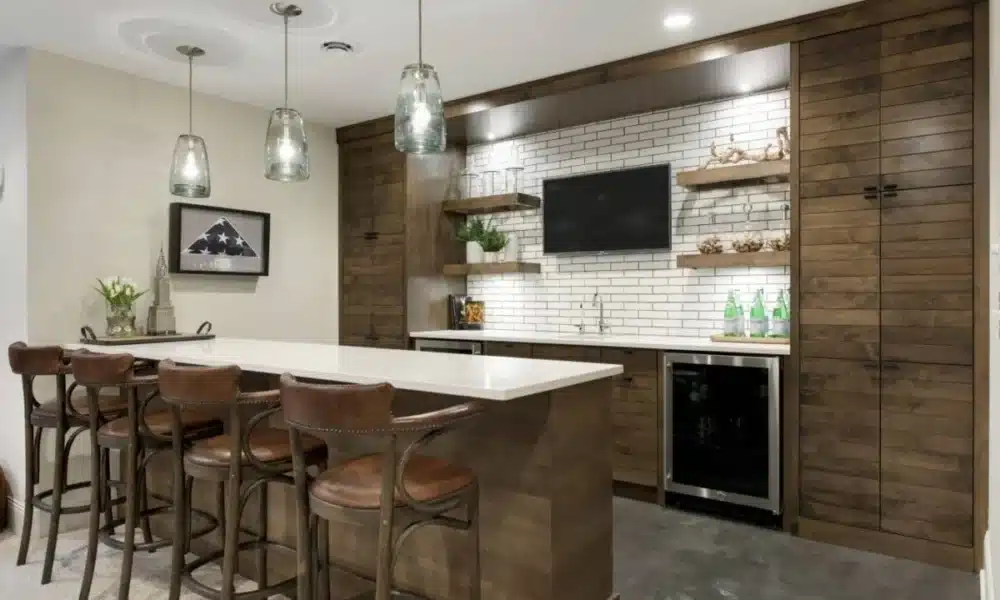
The best ideas for designing basement bar begin long before you choose a countertop or bar stool. A successful bar has to fit the room, work with existing plumbing and electrical service, leave comfortable circulation space, handle basement moisture, and support the way you actually entertain.
Table Of Content
- Start With the Basement, Not the Bar
- 1. Decide Between a Wet Bar and a Dry Bar Early
- What is a dry bar?
- What is a wet bar?
- 2. Put the Bar Where People Naturally Gather
- A good basement arrangement might be
- 3. Use a One-Wall Bar When Space Is Limited
- 4. Consider an L-Shaped Bar for Entertaining
- 5. Design the Bar Around Real Storage Needs
- 6. Use Drawers Instead of Too Many Lower Cabinets
- 7. Make the Beverage Refrigerator Easy to Reach
- 8. Choose Countertops for Spills, Not Just Appearance
- Quartz
- Granite
- Solid surface
- Butcher block
- Porcelain or tile
- 9. Build Lighting in Layers
- Ambient lighting
- Task lighting
- Decorative lighting
- 10. Treat Moisture Problems Before Building Cabinetry
- 11. Choose Basement Flooring Before Finalizing the Bar
- 12. Use a Backsplash to Give a Small Bar More Character
- 13. Use Open Shelves Selectively
- 14. Create a Basement Bar Without Alcohol-Specific Design
- 15. Coordinate the Bar With the TV and Entertainment Zone
- 16. Think About Sound Before the Party Starts
- 17. Build the Bar Into the Basement Budget, Not On Top of It
- Small Basement
- Good target
- Medium Basement
- Large Entertainment Basement
- Ignoring moisture
- Oversizing the bar
- Forgetting appliance ventilation
- Too little electrical planning
- Too much open shelving
- Designing cabinetry before selecting appliances
- Poor lighting
- Treating the bar as a separate room
- Spending the budget on finishes before basic basement work
- What is the best layout for a basement bar?
- Is a wet bar worth it in a basement?
- What is the difference between a wet bar and a dry bar?
- What should every basement bar have?
- How can I design a basement bar in a small space?
- What flooring is best around a basement bar?
- Should a basement bar have upper cabinets or open shelves?
- Does a basement bar need a permit?
- How do I make a basement bar look high-end?
Explore more ideas for designing basement bar that enhance your entertainment experience.
For some homeowners, that means a full wet bar with a sink, beverage refrigerator, cabinetry, and seating. For others, a compact dry bar against one wall does everything they need at a fraction of the complexity.
This My NEXT HOUSE PROJECT guide walks through layout, wet-versus-dry decisions, storage, lighting, countertops, seating, flooring, appliances, small-basement solutions, and practical remodeling considerations so you can build a bar that looks intentional and still works five years from now.
Implement innovative ideas for designing basement bar that reflect your personal style.
Start With the Basement, Not the Bar
Utilize ideas for designing basement bar for a cozy yet functional ambiance.
Before sketching cabinets, look carefully at the room around them.
A basement bar rarely exists by itself. It usually shares space with some combination of:
- a TV or media area
- sectional seating
- a game table
- stairs
- a bathroom
- mechanical equipment
- storage
- guest rooms
- a home gym
- exterior doors
The bar should support those functions rather than interrupt them.
Consider the top ideas for designing basement bar to optimize your space.
For example, putting a six-seat bar in the center of a modest basement may look impressive on a rendering but leave awkward paths between the stairs, sofa, bathroom, and television.
My NEXT HOUSE PROJECT’s guide to small basement design ideas is useful when several functions must share limited square footage.
A practical rule is simple:
Plan traffic first. Design the bar second.
1. Decide Between a Wet Bar and a Dry Bar Early
Choosing between wet or dry options is one of the crucial ideas for designing basement bar.
This decision affects almost everything that follows.
What is a dry bar?
Incorporate various ideas for designing basement bar to enhance functionality.
A dry bar provides a serving surface, cabinetry, storage, and often a beverage refrigerator, but it has no sink.
It is usually the simpler choice because it does not require new water supply and drainage.
A dry bar can still include:
- wine storage
- glassware
- beverage refrigerator
- ice maker, depending on appliance requirements
- microwave
- coffee station
- floating shelves
- under-cabinet lighting
What is a wet bar?
A wet bar includes a sink with plumbing.
That makes drink preparation and cleanup easier, especially when the basement is far from the kitchen.
However, plumbing location can significantly affect cost and construction complexity.
Among the most important ideas for designing basement bar is placing a wet bar near existing plumbing whenever the layout allows it. Building near a basement bathroom, laundry area, or existing drain stack may simplify the project compared with locating the bar on the opposite side of the basement.
For the best functionality, explore ideas for designing basement bar that suit your needs.
Always have plumbing and permit requirements evaluated for the actual house.
2. Put the Bar Where People Naturally Gather
Watch for common mistakes when implementing ideas for designing basement bar.
Don’t choose the bar location because one wall happens to be empty.
Watch how the room will be used.
A good bar usually sits close enough to the main entertainment area that someone making a drink remains part of the conversation.
At the same time, it should not sit directly in the primary traffic path.
A good basement arrangement might be:
Stairs → bar → lounge seating → TV
Or:
Bar → game table → lounge area
This gives guests a logical sequence through the room.
Houzz’s basement-bar gallery shows thousands of real-world installations in linear, L-shaped, compact, walk-behind, and entertainment-focused layouts, which is useful for studying how designers integrate bars into complete basement plans rather than treating them as isolated cabinetry.
3. Use a One-Wall Bar When Space Is Limited
Review ideas for designing basement bar that maximize limited space.
Not every basement needs an island-style bar with stools on both sides.
A single-wall bar is one of the most efficient small basement bar ideas.
Think of it as a compact kitchenette:
- lower cabinets
- countertop
- beverage refrigerator
- sink if desired
- backsplash
- upper cabinets or shelves
This configuration preserves floor area for seating, games, or family use.
It can also be installed beneath a soffit or along an otherwise difficult wall.
For very compact basements, eliminate bar stools entirely and let the counter serve as a beverage and snack station.
The lounge furniture can provide the seating.
4. Consider an L-Shaped Bar for Entertaining
Explore L-shaped layouts with ideas for designing basement bar for entertaining.
An L-shaped layout creates separation between the person preparing drinks and the guests sitting at the bar.
It can provide substantially more:
- countertop area
- storage
- seating
- workspace
- appliance space
But it also consumes more floor area.
Before committing, tape the proposed footprint onto the basement floor.
Add the stool locations.
Then walk around it.
If people constantly have to squeeze between the bar stools and another piece of furniture, the layout is too large for the room.
This simple test is one of the most useful ideas for designing basement bar because it exposes circulation problems before cabinetry is ordered.
5. Design the Bar Around Real Storage Needs
Beautiful open shelving is everywhere in basement-bar photography.
In actual homes, not everything deserves to be displayed.
Before designing the cabinetry, inventory what you intend to store:
-
- wine bottles
Prioritize storage with ideas for designing basement bar that meet your needs.
- liquor bottles
- beer
- glasses
- cocktail tools
- serving trays
- coffee equipment
- snacks
- napkins
- cleaning supplies
- small appliances
Then separate those items into display storage and hidden storage.
Use open shelving for attractive bottles and glassware.
Use drawers and cabinets for everything else.
A basement bar generally looks more polished when only selected items are visible.
6. Use Drawers Instead of Too Many Lower Cabinets
Utilize drawers for organization within your ideas for designing basement bar.
Traditional base cabinets often contain large doors with deep shelves.
For a bar, drawers can be more practical.
They make it easier to organize:
- bottle openers
- napkins
- coasters
- cocktail tools
- utensils
- wine accessories
- small serving pieces
Deep drawers can also hold bottles or bulkier supplies.
The same storage principles used in well-designed kitchens often translate effectively to bars, just at a smaller scale.
7. Make the Beverage Refrigerator Easy to Reach
A beverage refrigerator should not automatically go wherever a cabinet opening happens to fit.
Think about who will use it.
If guests need to walk behind the serving area every time they want a drink, traffic becomes awkward.
When possible, position the refrigerator where it is accessible without interfering with the main prep zone.
Also check the appliance installation instructions before enclosing it in cabinetry.
Freestanding and built-in refrigeration units can have different ventilation-clearance requirements. Never assume a freestanding dorm-style refrigerator can simply be boxed into custom cabinets.
Plan your layout around the most effective ideas for designing basement bar.
8. Choose Countertops for Spills, Not Just Appearance
Basement bar counters deal with:
- water
- citrus
- wine
- mixers
- condensation
- food
- ice
- frequent wiping
That makes easy maintenance important.
Popular basement bar countertop ideas include:
Choose materials based on ideas for designing basement bar for durability.
Quartz
Low maintenance and available in a broad range of colors and patterns.
Granite
Durable and visually substantial, but natural stone maintenance requirements vary.
Solid surface
Offers a clean, relatively seamless appearance and can work particularly well in contemporary spaces.
Butcher block
Warm and attractive, but requires appropriate finishing and maintenance around water.
Porcelain or tile
Can provide strong durability and design flexibility, though grout introduces additional cleaning considerations.
Don’t choose the bar countertop in isolation. Coordinate it with the basement flooring, cabinet color, lighting, and nearby fireplace or media wall.
9. Build Lighting in Layers
A basement bar should not depend on one bright ceiling fixture.
Good lighting usually comes from several sources.
Ambient lighting
Provides general room illumination.
Examples:
- recessed fixtures
- flush mounts
- track lighting
Task lighting
Illuminates actual work surfaces.
Examples:
- under-cabinet lighting
- shelf lighting
- focused ceiling fixtures
Decorative lighting
Establishes personality.
Examples:
- pendants
- sconces
- backlit shelving
- integrated cabinet lighting
A pair of pendants above a seated counter can visually define the bar without requiring walls.
Layer your lighting with innovative ideas for designing basement bar.
Dimmers are particularly useful because the same basement may need brighter lighting for cleanup and softer lighting during a movie or gathering.
10. Treat Moisture Problems Before Building Cabinetry
This step is far less exciting than choosing bar finishes.
It is also more important.
If the basement has:
- recurring water intrusion
- damp walls
- slab moisture
- musty odors
- condensation
- mold
- high humidity
deal with those conditions before installing cabinets, drywall, wood trim, or flooring.
The U.S. Environmental Protection Agency advises homeowners to inspect basements for leaks and other moisture problems before converting them into living spaces, and to correct moisture problems before proceeding with remodeling.
Address moisture first with effective ideas for designing basement bar.
For homeowners dealing with humidity rather than active leakage, My NEXT HOUSE PROJECT also has a guide explaining why basement dehumidification and moisture management matter.
A luxury bar built against a damp foundation wall is not an upgrade.
It is a repair waiting to happen.
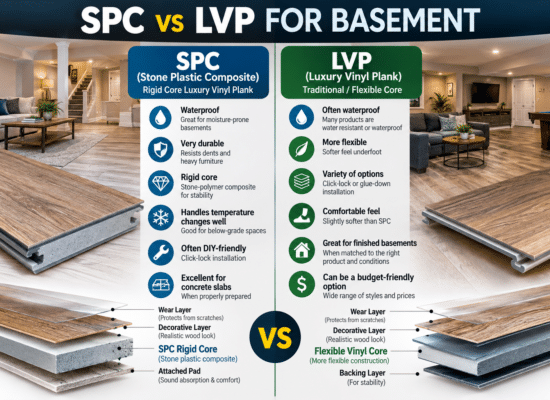
11. Choose Basement Flooring Before Finalizing the Bar
Cabinetry sits on or interacts with the finished floor, so flooring decisions should happen early.
Good options can include:
- luxury vinyl plank
- tile
- epoxy
- engineered flooring approved for below-grade applications
- polished or finished concrete
Which one makes sense depends on moisture conditions, comfort, slab preparation, and the surrounding basement use.
If you’re comparing costs, see My NEXT HOUSE PROJECT’s guide on how to save on basement flooring costs without cutting corners.
For concrete floors, the site’s DIY epoxy basement floor guide emphasizes testing the slab for moisture before applying a coating.
Homeowners considering resilient plank flooring can also review the guide to waterproof LVP flooring for basements.
The important point is not that one material is universally best.
It is that basement flooring should be selected for below-grade conditions first and décor second.
12. Use a Backsplash to Give a Small Bar More Character
Enhance your bar with creative ideas for designing basement bar for character.
A basement bar often occupies only one wall.
That means the backsplash carries more visual weight than it might in a full kitchen.
Potential options include:
- subway tile
- handcrafted-look ceramic tile
- stone
- brick veneer
- mirror
- metal
- large-format porcelain
- wood-look surfaces appropriate for the location
If the cabinets and countertop are simple, a more expressive backsplash can become the focal point.
If the bar already contains dramatic cabinetry, strong veining, open shelves, and decorative lighting, keep the backsplash quieter.
Not every surface needs to compete for attention.
13. Use Open Shelves Selectively
Selectively use open shelving as part of your ideas for designing basement bar.
Floating shelves can make a basement bar feel less like a kitchen.
They’re useful for displaying:
- bottles
- cocktail glasses
- decanters
- artwork
- a few decorative objects
But open shelving only looks elegant when it has breathing room.
Don’t design five shelves because the wall can technically hold five.
Two substantial shelves may look better than an entire wall of exposed storage.
Houzz examples show floating shelves used effectively as both bottle storage and a visual bridge between cabinetry and adjacent entertainment spaces.
14. Create a Basement Bar Without Alcohol-Specific Design
A home bar does not have to revolve around liquor.
Incorporate flexibility in your ideas for designing basement bar.
The same cabinetry can function as:
- coffee bar
- soda station
- snack center
- dessert bar
- beverage station
- entertaining kitchenette
That flexibility can be valuable in a family basement.
Include:
- beverage refrigeration
- glassware
- mugs
- microwave
- snack drawers
- coffee equipment
- sparkling-water storage
Designing around general entertaining rather than bottles alone can make the space useful every day.
15. Coordinate the Bar With the TV and Entertainment Zone
Ensure coordination with ideas for designing basement bar for a cohesive look.
One common basement layout problem is having every feature compete for attention.
The television has one visual style.
The fireplace has another.
The bar has another.
The game area introduces yet another.
Instead, repeat a few materials throughout the basement.
For example:
Bar: walnut cabinetry + black hardware
TV wall: walnut shelving + black sconces
Game area: black metal table details
Floor: warm neutral finish
Repeating finishes makes separate zones feel connected.
My NEXT HOUSE PROJECT’s small basement design guide similarly emphasizes zoning a basement around multiple functions rather than designing every area separately.
16. Think About Sound Before the Party Starts
Consider sound control as part of your ideas for designing basement bar.
Bars, television rooms, gaming areas, and hard flooring can create considerable noise.
In a basement beneath bedrooms or main living areas, sound control deserves attention during construction rather than afterward.
Possible strategies may involve:
- insulation in ceiling cavities
- resilient assemblies
- additional drywall layers
- acoustic detailing
- door selection
- soft furnishings
The exact assembly should be selected according to the noise problem and construction.
For a deeper explanation, see My NEXT HOUSE PROJECT’s guide on how to soundproof a basement ceiling.
Soundproofing is considerably easier when the ceiling is already open.
17. Build the Bar Into the Basement Budget, Not On Top of It
Budget wisely with your ideas for designing basement bar to avoid overspending.
A common remodeling mistake is budgeting for the bar before accounting for everything required to make the basement usable.
The broader project may also require:
- framing
- insulation
- drywall
- electrical work
- HVAC modifications
- plumbing
- flooring
- lighting
- ceiling work
- painting
- permits
- egress improvements
- moisture repairs
If the basement is unfinished, establish the complete finishing budget before assigning a large percentage to cabinetry and countertops.
My NEXT HOUSE PROJECT’s guide to the cost to finish a basement breaks the project into the larger cost categories homeowners need to consider.
For budget-conscious projects, also review these budget-friendly basement ideas.

Ideas for Designing a Basement Bar by Available Space
Small Basement
Use:
- one-wall cabinetry
- 24-inch beverage refrigerator
- floating shelves
- under-cabinet lighting
- compact sink only if plumbing justifies it
- no dedicated bar seating if lounge seating is nearby
Keep the visual footprint low.
Good target
A small beverage center that supports the room instead of dominating it.
Medium Basement
Consider:
- straight or L-shaped bar
- 2–4 stools
- sink
- beverage refrigerator
- drawers
- glassware storage
- decorative shelving
This size usually offers the best balance between function and available floor area.
Large Entertainment Basement
You may have room for:
- walk-behind bar
- 4–6 seats
- larger refrigerator
- wine storage
- dishwasher drawer or compact dishwasher where appropriate
- ice maker
- sink
- extensive cabinetry
- back-bar shelving
Even in a large room, don’t automatically maximize the bar.
Guests still need somewhere to sit away from it.
Modern Basement Bar Ideas
Explore popular ideas for designing basement bar for a modern touch.
Modern bars work best when visual clutter stays under control.
Consider:
- flat-panel cabinetry
- quartz counters
- integrated appliances
- concealed storage
- large-format backsplash
- restrained hardware
- warm LED lighting
- wood accents
Black cabinetry can look sophisticated in a basement, but compensate for limited natural light with deliberate illumination.
Modern does not mean cold.
Oak, walnut, warm whites, bronze, textured tile, and muted stone surfaces can soften a clean-lined space.

Rustic Basement Bar Ideas
Implement rustic ideas for designing basement bar for a warm atmosphere.
A rustic bar can incorporate:
- reclaimed-looking wood
- brick
- natural stone
- dark metal
- wood shelves
- leather seating
- warm pendant lighting
The key is editing.
Using barn wood, brick, stone, corrugated metal, vintage signs, Edison bulbs, and heavy timber all at once can turn the room into a theme set.
Choose two or three strong materials and repeat them consistently.
Houzz’s current rustic-basement gallery shows bars using combinations of natural stone, wood, metal, brick, and warm lighting without requiring every rustic element in one room.
Basement Bar Seating: How Much Is Too Much?
Ensure proper seating with your ideas for designing basement bar.
Bar stools take more room than people expect.
You need space for:
- the stool itself,
- the person sitting on it,
- room to pull it out,
- circulation behind it.
A bar that technically fits five stools may function better with four.
People need elbow room, especially when eating.
Before ordering stools, mark their positions with boxes, chairs, or painter’s tape and test how the room feels.
Also consider:
- counter height
- stool height
- footrest
- seat width
- back support
- swivel clearance
Comfort matters more than squeezing in one extra seat.
Where Should the Sink Go?
If you build a wet bar, position the sink where it supports the workflow.
A useful sequence might be:
refrigerator → prep counter → sink → serving area
Avoid installing an oversized sink simply because the base cabinet can accommodate it.
A basement bar is not necessarily a second kitchen.
For most beverage-focused spaces, preserving countertop area may matter more than installing a large basin.
Plumbing layout, venting, drainage, shutoffs, permits, and local requirements should be reviewed by qualified professionals.
Basement Bar Design Mistakes to Avoid
Avoid common mistakes while using ideas for designing basement bar.
Some mistakes become expensive after the cabinets arrive.
Ignoring moisture
Never cover an unresolved basement water problem with new finishes.
Oversizing the bar
The basement should still function when every stool is occupied.
Forgetting appliance ventilation
Check the manufacturer specifications before enclosing refrigeration.
Too little electrical planning
Think about refrigerators, lighting, coffee makers, TVs, charging, ice makers, and future equipment before drywall closes the walls.
Too much open shelving
Real homes need concealed storage.
Designing cabinetry before selecting appliances
Appliance dimensions should inform cabinet openings, not the reverse.
Poor lighting
Dark cabinetry plus a dark basement plus one ceiling fixture rarely produces an inviting bar.
Treating the bar as a separate room
Repeat finishes from the rest of the basement.
Spending the budget on finishes before basic basement work
Dryness, electrical service, plumbing, HVAC, and flooring come first.
What Is the Best Basement Bar Layout?
Review effective ideas for designing basement bar layouts for functionality.
For many homeowners, the most practical answer is surprisingly simple:
A one-wall wet or dry bar positioned beside the entertainment area with enough storage, a beverage refrigerator, good lighting, and plenty of uninterrupted counter space.
It is less dramatic than a large pub-style island.
But it leaves more basement available for actual living.
For homeowners who entertain frequently and have substantial square footage, an L-shaped or walk-behind bar can justify the additional cabinetry and circulation area.
The best ideas for designing basement bar are not the biggest ones.
They are the ones that make the basement easier to use.
Key Takeaways
Remember key principles with your ideas for designing basement bar.
- Start with traffic flow and room zoning before designing cabinetry.
- Decide wet versus dry early because plumbing can materially affect the project.
- Small basements often work best with a one-wall bar.
- Use drawers and closed cabinets for everyday clutter and reserve open shelving for selected display pieces.
- Position beverage refrigeration where guests can reach it without crossing the work zone.
- Choose countertops and flooring for spills, moisture, and maintenance.
- Use ambient, task, and decorative lighting together.
- Resolve basement moisture before installing finishes or cabinets. The EPA explicitly recommends correcting moisture problems before basement conversion or remodeling.
- Check appliance ventilation requirements before designing cabinet openings.
- Coordinate the bar with the rest of the basement rather than treating it as a stand-alone feature.
- Plan electrical, plumbing, HVAC, sound control, and flooring before cabinetry installation.
- Don’t let the bar consume money needed for the basic basement-remodeling scope.
FAQ Section – People Also Ask
Integrate common ideas for designing basement bar questions into your planning.
What is the best layout for a basement bar?
For many basements, a straight one-wall bar is the most space-efficient layout because it provides cabinetry, refrigeration, storage, and countertop area without consuming the center of the room. Larger basements may support L-shaped or walk-behind bars with dedicated seating.
Is a wet bar worth it in a basement?
A wet bar can be worthwhile if the basement is far from the kitchen or you entertain frequently. A sink makes rinsing glasses, preparing drinks, handling ice, and cleanup easier. However, plumbing location, drainage, permits, and construction costs should be evaluated before deciding.
What is the difference between a wet bar and a dry bar?
A wet bar includes a working sink and plumbing. A dry bar does not. Both may include cabinetry, a countertop, beverage refrigeration, wine storage, lighting, and glassware storage.
What should every basement bar have?
At minimum, a functional basement bar needs a durable counter, practical storage, good lighting, and convenient access to beverages. Many homeowners also add a beverage refrigerator, drawers, glassware storage, outlets, and a sink where plumbing makes sense.
How can I design a basement bar in a small space?
Use a single-wall layout with lower cabinets, a beverage refrigerator, countertop, and one or two shelves. Eliminate dedicated bar seating if the basement already has nearby lounge seating. Vertical storage can provide additional capacity without consuming floor space.
What flooring is best around a basement bar?
Materials commonly considered include luxury vinyl plank, tile, epoxy, and properly selected concrete finishes. The best option depends on slab moisture, spill resistance, comfort, budget, and manufacturer approval for below-grade installation.
Should a basement bar have upper cabinets or open shelves?
A combination often works best. Closed cabinets conceal supplies and clutter, while open shelving provides convenient access and a place to display attractive bottles or glassware. Too much open storage can make a small bar visually busy.
Does a basement bar need a permit?
Permit requirements vary by jurisdiction and project scope. A simple furniture-style dry bar may require little or no construction permitting, while adding plumbing, electrical circuits, structural changes, or extensive remodeling may trigger permits and inspections. Verify requirements with the local authority having jurisdiction before construction.
How do I make a basement bar look high-end?
Prioritize proportion and execution instead of adding more features. Well-fitted cabinetry, intentional lighting, a durable countertop, a coordinated backsplash, integrated refrigeration, concealed storage, and consistent finishes can create a polished appearance without turning the basement into a themed commercial bar.
For a polished look, follow ideas for designing basement bar that prioritize design.