
A plain ceiling can make an otherwise beautiful room feel unfinished. Decorative ceiling beams offer a practical way to introduce architectural character, warmth, and visual structure without necessarily changing the home’s framing. Whether you’re renovating a farmhouse kitchen, updating a living room, or adding interest to a vaulted ceiling, the right beam design can transform how the entire space feels.
Table Of Content
- What Are Decorative Ceiling Beams?
- 12 Decorative Ceiling Beams Ideas for Modern Homes
- 1. Natural Oak Beams for a Warm Contemporary Living Room
- 2. Rustic Reclaimed Wood Beams
- 3. Dark Walnut Beams Against White Ceilings
- 4. Faux Wood Beams for an Affordable Transformation
- 5. Decorative Beams on Vaulted Ceilings
- 6. Box Beams for a Clean Architectural Finish
- 7. White Painted Beams for Low Ceilings
- 8. Coffered Ceilings With Decorative Beams
- 9. Farmhouse Kitchen Ceiling Beams
- 10. Minimalist Ceiling Beams in Modern Interiors
- 11. Bedroom Ceiling Beams
- 12. Decorative Beams With Integrated Lighting
- Best Materials for Decorative Ceiling Beams
- Real Wood vs. Faux Wood Ceiling Beams
- How Much Do Decorative Ceiling Beams Cost in 2026?
- Decorative Ceiling Beams for 8-Foot and 9-Foot Ceilings
- Rooms With 8-Foot Ceilings
- Rooms With 9-Foot Ceilings
- Vaulted and Tall Ceilings
- How to Install Decorative Ceiling Beams Safely
- 1. Locate Suitable Structural Attachment Points
- 2. Plan the Layout
- 3. Check Electrical and Mechanical Services
- 4. Install the Approved Mounting System
- 5. Fit and Finish the Beams
- Common Decorative Ceiling Beam Mistakes
- Key Takeaways
- FAQ Section – People Also Ask
- Are decorative ceiling beams still in style in 2026?
- Do decorative ceiling beams make a room look smaller?
- Can you install faux wood beams on an existing drywall ceiling?
- What is the difference between faux and real wood ceiling beams?
- Can decorative beams be installed on an 8-foot ceiling?
- How far apart should decorative ceiling beams be?
- Can decorative ceiling beams support a ceiling fan?
- Can you install decorative ceiling beams yourself?
But not every ceiling needs heavy timber or an elaborate beam pattern. Ceiling height, room proportions, beam materials, lighting, and installation methods all influence the finished appearance.
This 2026 guide from My NEXT HOUSE PROJECT explores 12 ceiling beam ideas, compares real wood with faux alternatives, and explains how to plan an attractive installation without making common design mistakes.
What Are Decorative Ceiling Beams?
Decorative ceiling beams are architectural elements installed primarily to enhance the appearance of a ceiling. Unlike structural beams, which support building loads, decorative beams are generally non-load-bearing.
They can be manufactured from solid wood, hollow wood assemblies, polyurethane, fiberglass composites, or other materials designed to reproduce the appearance of exposed framing.

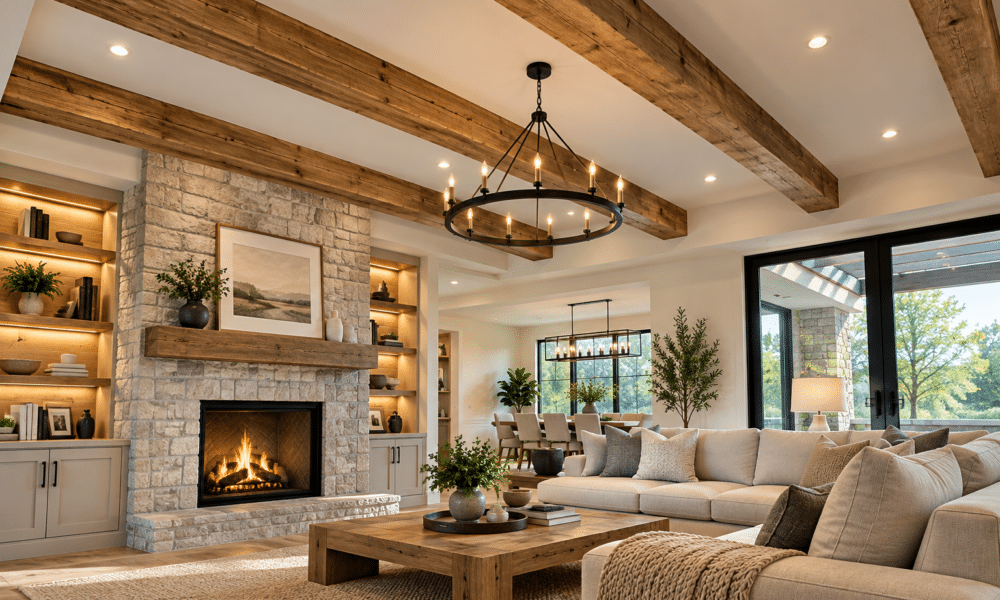
Natural wood beams create warmth and definition.

Dark beams provide architectural contrast.
The distinction between decorative and structural beams matters. A hollow faux beam can provide the appearance of heavy timber without the same weight or load-bearing function.
For homeowners, the main benefits include architectural character, the ability to define open-plan spaces, visual warmth, and, in certain installations, a way to conceal suitable wiring or other nonstructural elements.
However, ceiling beams also affect how tall, wide, and open a room appears. Choosing the right proportions is just as important as choosing the material.
12 Decorative Ceiling Beams Ideas for Modern Homes
1. Natural Oak Beams for a Warm Contemporary Living Room

Light oak beams pair beautifully with white ceilings, neutral walls, and natural textures.
They introduce warmth without the heavy appearance of dark-stained timber. This combination works especially well in contemporary, transitional, and Scandinavian-inspired interiors.
For a cohesive design, coordinate the beam finish with flooring, built-in cabinetry, or furniture. Exact color matching isn’t necessary; complementary undertones usually look more natural.
2. Rustic Reclaimed Wood Beams

Reclaimed wood beams bring weathered texture, knots, saw marks, and natural variation into the room.
They are particularly effective in farmhouse, mountain, and rustic interiors.
Authentic reclaimed timber can be heavy and irregular, so decorative hollow beams made with reclaimed wood may offer a more manageable alternative.
Inspect reclaimed materials for moisture, insect damage, contamination, and suitability before installation.
3. Dark Walnut Beams Against White Ceilings

Dark beams create a strong architectural statement.
Against a white ceiling, walnut-toned or espresso-stained beams draw attention upward and can emphasize the room’s length.
This approach is especially effective in spaces with generous ceiling height, large windows, and light-colored furnishings.
For smaller rooms, use fewer beams rather than filling the ceiling with dark wood.
4. Faux Wood Beams for an Affordable Transformation

Faux wood ceiling beams can reproduce the look of natural timber without the same weight.
Many are hollow, making them easier to handle than solid beams of comparable dimensions. They can also be useful when existing framing limits the amount of additional weight that can be supported.
The quality of faux finishes varies considerably. Look closely at grain patterns, seams, corners, and how the material looks under actual room lighting.
5. Decorative Beams on Vaulted Ceilings

Vaulted ceilings provide an excellent opportunity to introduce substantial architectural detail.
Beams can follow the roof slope, cross the ceiling, or form a decorative truss-like arrangement.
The design should complement the roof geometry rather than compete with it.
For dramatic vaulted ceilings, fewer well-proportioned beams often look better than an unnecessarily complicated pattern.
6. Box Beams for a Clean Architectural Finish
Box beams are hollow assemblies commonly constructed from finished lumber, plywood, or other suitable materials.
Their rectangular profiles create crisp lines that suit contemporary and transitional interiors.
Unlike rough-hewn timber, box beams can be finished with smooth surfaces, carefully aligned joints, and consistent dimensions.
They can also be painted to blend with the ceiling rather than contrast against it.
7. White Painted Beams for Low Ceilings
Not every decorative beam needs a wood-grain finish.
Painting beams the same white as the ceiling creates subtle architectural depth without introducing strong visual contrast.
This can be particularly effective in rooms where ceiling height is limited.
The result is understated and works well with traditional, coastal, cottage, and transitional design styles.
8. Coffered Ceilings With Decorative Beams

A coffered ceiling uses intersecting beams or trim assemblies to create recessed-looking panels.
The pattern introduces rhythm and architectural formality.
Coffered designs work especially well in dining rooms, home offices, formal living rooms, and larger bedrooms.
Before installation, carefully plan the grid around ceiling fixtures, room dimensions, and existing architectural features.
9. Farmhouse Kitchen Ceiling Beams

Wood beams can soften the hard surfaces typically found in kitchens.
They complement painted cabinets, stone countertops, metal fixtures, and tile backsplashes.
One particularly effective combination is a white kitchen with medium-toned oak beams and restrained black or bronze accents.
Coordinate beam placement with pendant lights, range ventilation, cabinet heights, and sprinkler or smoke-alarm requirements where applicable.
10. Minimalist Ceiling Beams in Modern Interiors
Modern ceiling beams don’t need to imitate rustic barns.
Slim, clean-lined beams with consistent spacing can add definition while maintaining a contemporary aesthetic.
Natural oak, dark-stained wood, or painted finishes all work.
The important detail is restraint: avoid adding more visual elements than the room needs.
11. Bedroom Ceiling Beams

In bedrooms, beams can introduce warmth and make a large ceiling feel more intimate.
A simple arrangement of two or three beams may be enough.
Lighter finishes generally feel calmer, while dark timber produces a more traditional or dramatic appearance.
Consider how beams align with the bed, windows, ceiling fan, and lighting.
12. Decorative Beams With Integrated Lighting

Lighting can make ceiling beams more functional as well as decorative.
Possible approaches include recessed downlights between beams, indirect LED illumination, or carefully placed pendants.
Electrical wiring must be installed according to applicable codes and the fixture manufacturer’s instructions. Hollow decorative beams should not be assumed to provide an approved electrical enclosure or mounting structure.
For an especially polished appearance, coordinate the lighting layout before beam installation begins.
Best Materials for Decorative Ceiling Beams
Material selection affects weight, cost, appearance, installation difficulty, and long-term maintenance.
| Material | Advantages | Limitations |
|---|---|---|
| Solid wood | Authentic grain and substantial appearance | Heavy, potentially expensive, may move with humidity |
| Hollow wood box beams | Genuine wood appearance with reduced weight | Requires accurate fabrication and finishing |
| Polyurethane faux beams | Lightweight, many realistic finishes | Quality varies; some look artificial up close |
| Fiberglass composite | Durable and available in larger decorative profiles | Specialized installation and potentially higher cost |
| Painted MDF or wood assemblies | Smooth contemporary appearance | Moisture sensitivity and weight must be considered |
Real Wood vs. Faux Wood Ceiling Beams
For a renovation where authentic material is the priority, wood box beams are often an excellent compromise between solid timber and manufactured alternatives.
For a homeowner seeking a decorative update with less weight, faux beams may be more practical.
Neither is automatically superior. The right choice depends on room conditions, budget, appearance, and the available attachment structure.
How Much Do Decorative Ceiling Beams Cost in 2026?
Costs vary considerably by material, size, finish, ceiling height, and installation complexity.
The following figures are illustrative planning allowances, not verified national averages or contractor quotations.
| Beam type | Approximate material allowance per linear foot |
|---|---|
| Basic polyurethane faux beam | $15–$40 |
| Premium textured faux beam | $30–$75 |
| Custom hollow wood beam | $25–$90+ |
| Solid decorative timber | $40–$150+ |
Professional installation, staining, painting, lift or scaffold rental, electrical modifications, and structural reinforcement where necessary are additional.
For example, a simple design using three 12-foot beams requires 36 linear feet of material. At an assumed $35 per linear foot, the beam material alone would total $1,260, before waste, fasteners, finishing, labor, or taxes.
Get quotes based on the complete installed project rather than comparing beam prices alone.
Decorative Ceiling Beams for 8-Foot and 9-Foot Ceilings
Ceiling height should influence beam dimensions.
Rooms With 8-Foot Ceilings
An 8-foot ceiling can accommodate some decorative beam designs, but restraint is important.
Choose shallow profiles, lighter finishes, and fewer beams. Avoid large, dark timber profiles that significantly reduce visual clearance.
Rooms With 9-Foot Ceilings
Nine-foot ceilings offer more flexibility for moderately sized beams, subtle coffering, and stronger wood contrasts.
Still, room width and beam spacing matter. An oversized beam can feel out of proportion even when the ceiling is relatively high.
Vaulted and Tall Ceilings
Taller spaces can accommodate larger beam profiles and more substantial decorative arrangements.
Before selecting dimensions, create a scaled drawing or use temporary cardboard mockups to evaluate the beam depth from normal standing and seated viewpoints.
How to Install Decorative Ceiling Beams Safely
Installation depends on the beam material and ceiling structure, but the planning sequence is broadly similar.
1. Locate Suitable Structural Attachment Points
Drywall alone should not be assumed to support a decorative beam.
Identify ceiling framing or another approved attachment system and verify that it can safely support the beam and hardware.
2. Plan the Layout
Mark beam positions, confirm spacing, and check for conflicts with lights, fans, vents, detectors, and other ceiling components.
3. Check Electrical and Mechanical Services
Determine whether concealed wiring, ductwork, plumbing, or other services affect attachment locations.
Never drill blindly into concealed ceiling cavities.
4. Install the Approved Mounting System
Follow the manufacturer’s instructions for cleats, fasteners, anchors, and other components.
Heavy timber installations may require a qualified contractor or structural professional.
5. Fit and Finish the Beams
Install the beams, inspect alignment, and finish joints or fastener locations as appropriate.
Avoid improvising attachment details, especially over occupied living spaces.
Important: Decorative beams are not intended to support structural loads, ceiling fans, or suspended fixtures unless the complete system has been specifically designed and approved for that purpose.
Common Decorative Ceiling Beam Mistakes
The most expensive mistakes often begin during design rather than installation.
Oversized beams: Large profiles can overpower small rooms and reduce perceived ceiling height.
Too many beams: Closely spaced beams may make a ceiling look cluttered rather than architectural.
Ignoring lighting: Poor placement can create awkward shadows or conflict with recessed fixtures.
Mismatched finishes: A strongly orange wood stain can clash with cool-gray flooring or cabinetry.
Improper fastening: A lightweight appearance does not guarantee that a product can be attached directly to drywall.
Confusing decorative with structural: Hollow beams and faux trusses should never be represented as load-bearing components.
For most homes, a simpler beam arrangement with carefully selected proportions creates a more convincing result than an elaborate design without architectural justification.
Key Takeaways
-
Decorative ceiling beams can add architectural interest without changing the home’s structural framing.
-
Faux wood beams are often easier to handle than solid timber because of their lower weight.
-
Hollow wood box beams provide a useful balance between authentic materials and manageable installation.
-
Ceiling height, beam depth, spacing, and finish determine whether a room feels open or visually crowded.
-
Light-colored beams are worth considering for lower ceilings; darker beams create stronger contrast in larger rooms.
-
Plan lighting and ceiling fixtures before installation.
-
Proper fastening is essential. Decorative beams must not be treated as structural supports.
-
Compare complete installed costs rather than material prices alone.
FAQ Section – People Also Ask
Are decorative ceiling beams still in style in 2026?
Yes. Wood-look beams remain relevant in farmhouse, transitional, rustic, and contemporary interiors. The most enduring designs use beam proportions and finishes that complement the room’s architecture rather than relying on an elaborate pattern simply because it is fashionable.
Do decorative ceiling beams make a room look smaller?
They can, especially when oversized dark beams are installed on a low ceiling. Shallow profiles, light finishes, and restrained spacing help maintain an open appearance.
Can you install faux wood beams on an existing drywall ceiling?
Often, yes, provided the product is approved for the application and the required mounting system is correctly installed. Follow the manufacturer’s instructions for blocking, anchors, adhesives, and fasteners. Ekena Millwork provides product-specific installation details for its faux beam systems.
What is the difference between faux and real wood ceiling beams?
Real wood provides natural grain and authentic material character. Faux beams reproduce that appearance using lighter manufactured materials. Both can be decorative and nonstructural.
Can decorative beams be installed on an 8-foot ceiling?
Yes, in some designs. Use shallow profiles and avoid excessive visual weight. Mock up the proposed dimensions before purchasing to determine whether the reduced clearance and appearance are acceptable.
How far apart should decorative ceiling beams be?
There is no universal spacing requirement for appearance. Spacing depends on room dimensions, beam depth, ceiling shape, and the desired visual effect. Decorative layout spacing is separate from the manufacturer’s required fastening or blocking intervals.
Can decorative ceiling beams support a ceiling fan?
No. Decorative faux beams are not structural supports. Ceiling fans and heavy light fixtures need an independently approved mounting system attached to suitable framing or another code-compliant support.
Can you install decorative ceiling beams yourself?
Some lightweight faux beam systems are suitable for experienced DIY homeowners. Heavy wood beams, high ceilings, complex layouts, or installations involving electrical work may require professional assistance.