
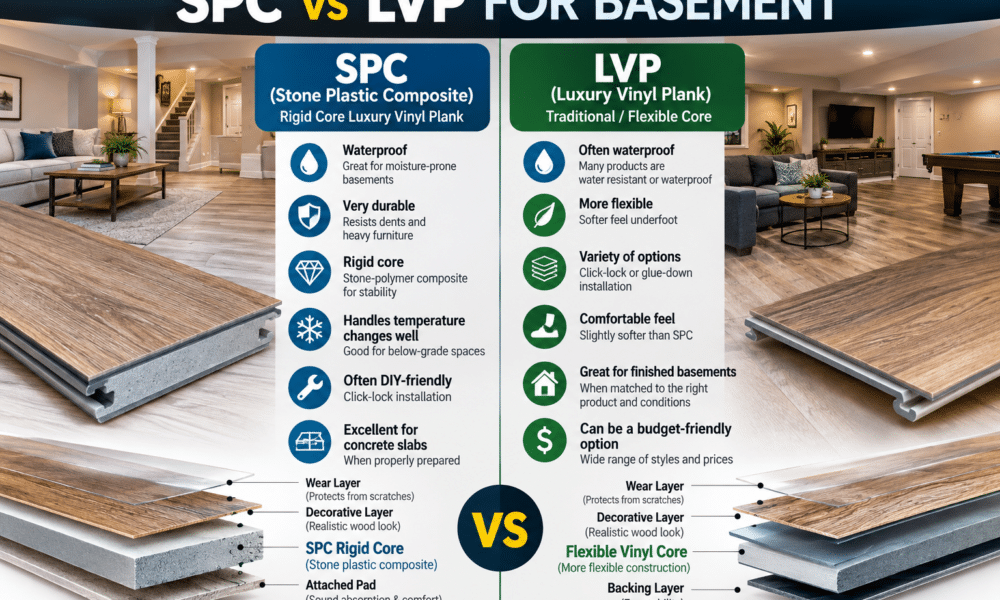
For many finished basements, SPC rigid-core LVP is an excellent option because its dense composite core provides dimensional stability, good dent resistance, and waterproof plank construction. Current rigid-core vinyl products are widely marketed for moisture-prone areas, including basements. This guide will help you understand the differences in spc vs lvp for basement flooring. SPC vs LVP for basement options can vary significantly. MSI Surfaces
Table Of Content
- Quick SPC vs LVP Basement Comparison
- First, Understand What SPC and LVP Actually Mean
- What Is LVP?
- What Is SPC Flooring?
- Why Basements Change the Flooring Decision
- Concrete Can Transmit Moisture
- Waterproof Flooring Does Not Waterproof a Basement
- Why SPC Flooring Works Well in Many Basements
- 1. The Core Is Dense and Rigid
- 2. SPC Is Dimensionally Stable
- 3. Click-Lock Installation Can Be DIY-Friendly
- Where SPC Can Disappoint in a Basement
- SPC Can Feel Hard
- A Concrete Slab Can Make It Feel Cold
- Rigid Doesn’t Mean It Can Bridge a Bad Slab
- When Traditional or Flexible LVP Makes More Sense
- You Have a Very Flat, Properly Prepared Slab
- Finished Floor Height Is Tight
- You’re Covering a Large Open Area
- SPC vs LVP Over Concrete: Preparation Matters More Than Marketing
- Check the Slab for Moisture
- Check Flatness, Not Just Level
- Deal With Cracks Intelligently
- Don’t Choose Basement LVP by Thickness Alone
- Look at the Wear Layer
- Inspect the Locking System
- Look at the Attached Pad
- Verify Below-Grade Approval
- SPC vs LVP for a Finished Basement: Choose by Room Use
- Basement Family Room
- Basement Bar
- Home Gym
- Guest Bedroom
- Utility or Mechanical Room
- What About Flooding?
- SPC vs Waterproof LVP: Don’t Let the Labels Confuse You
- 2026 Update: What We Would Change From a 2024 LVP Basement Guide
- How Much Should You Spend on Basement Vinyl Flooring?
- Our Practical Decision Rule for SPC vs LVP for Basement Projects
- Is SPC or LVP better for a basement?
- Is SPC flooring really waterproof?
- Can SPC flooring be installed directly over basement concrete?
- Do I need a moisture barrier under SPC in a basement?
- Is SPC colder than regular LVP in a basement?
- Can mold grow under waterproof vinyl plank flooring?
- Is SPC good for uneven basement floors?
- What thickness of SPC is best for a basement?
- Should I choose SPC or epoxy for a basement floor?
But that does not mean SPC automatically wins every basement project.
When considering spc vs lvp for basement options, think about your specific needs and the environment of your basement.
Traditional or flexible LVP can make sense when you want a thinner floor, are using a glue-down installation, have a properly prepared slab, or need a flooring system suited to a particular room or manufacturer specification.
In the discussion of spc vs lvp for basement flooring, always account for moisture conditions and your flooring installation method.
More importantly, neither material fixes a wet basement.
Choosing between spc vs lvp for basement flooring should consider not only the material but also the installation technique.
A waterproof plank can survive contact with water without swelling like fiberboard, but water can still travel under the floor, affect adhesives, encourage microbial growth in dust and organic debris, or signal a larger foundation or drainage problem.
Evaluating spc vs lvp for basement options can reveal the best choice for your home’s specific needs.
That distinction should drive the entire decision.
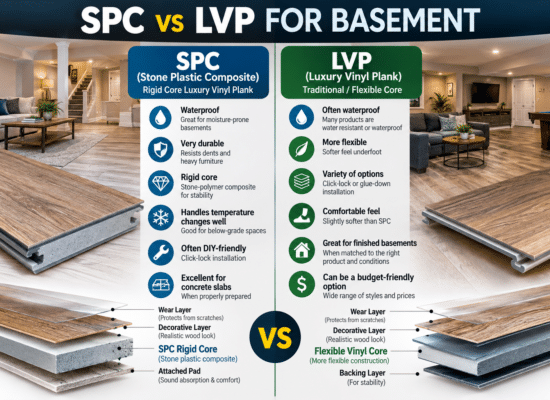
Quick SPC vs LVP Basement Comparison
The spc vs lvp for basement debate often hinges on specific user experiences and basement conditions.
| Feature | SPC Rigid-Core LVP | Flexible/Traditional LVP |
|---|---|---|
| Core | Dense stone-polymer/plastic composite | Flexible vinyl construction |
| Water resistance | Typically waterproof plank construction | Often waterproof or highly water resistant; verify product |
| Dent resistance | Generally very good | Product-dependent |
| Underfoot feel | Firmer | Usually somewhat more flexible |
| Concrete slab use | Excellent when product is approved | Excellent with proper substrate/product |
| Installation | Commonly click-lock floating | Click-lock or glue-down depending on product |
| Subfloor flatness | Still important | Especially important with thinner products |
| DIY potential | Often good | Varies by installation system |
| Heavy furniture | Strong choice | Depends on product and installation |
| Basement suitability | Very good when moisture is controlled | Very good with correct specification |
Bottom line: don’t buy based solely on the letters SPC or LVP. Buy according to the complete flooring system and the condition of your basement.
With these insights, the spc vs lvp for basement comparison can be made with confidence.
First, Understand What SPC and LVP Actually Mean
Understanding core differences in spc vs lvp for basement is essential for your project.
Flooring terminology has become unnecessarily confusing.
What Is LVP?
To grasp the benefits of spc vs lvp for a basement, start with fundamental definitions.
LVP stands for luxury vinyl plank. It describes a vinyl flooring format designed primarily to reproduce the appearance of wood planks.
A typical product contains several layers, which can include:
Further, consider how each material fit into the spc vs lvp for basement narrative.
-
- a protective wear layer
- a decorative printed layer
Assessing performance characteristics of spc vs lvp for basement is crucial in choosing the right product.
-
- a vinyl layer
- a core
In the end, understanding spc vs lvp for basement can simplify your decision-making process.
- an attached pad or backing on some products
Not every LVP has the same core.
The final comparison of spc vs lvp for basement should reflect your unique needs and preferences.
That is where SPC enters the picture.
What Is SPC Flooring?
Consequently, spc vs lvp for basement choices are best explored with a clear understanding of features.
SPC generally stands for stone plastic composite or stone polymer composite. It is a rigid-core form of vinyl flooring that typically combines mineral material such as limestone with polymers to create a dense core.
MSI, for example, describes SPC as denser and more rigid than foamed WPC flooring, while current Shaw SPC products are marketed as waterproof luxury vinyl flooring. MSI Surfaces
The ultimate question in flooring remains spc vs lvp for basement — which is best for your needs?
So when someone asks:
“Is SPC better than LVP?”
To summarize, the spc vs lvp for basement decision can significantly impact your renovation experience.
the technically accurate response is:
SPC can be LVP.
Every project’s success hinges on making the right spc vs lvp for basement choice.
The better homeowner question is:
Should I choose rigid-core SPC LVP or a more conventional flexible/glue-down luxury vinyl plank for my basement?
Ultimately, the best flooring aligns with your unique spc vs lvp for basement requirements.
That is the comparison that actually helps you choose a floor.
As you weigh spc vs lvp for basement, remember to keep your priorities in mind.
Why Basements Change the Flooring Decision
A beautiful flooring sample sitting under showroom lighting tells you almost nothing about how that product will behave in your basement.
To conclude, the spc vs lvp for basement debate reflects practical considerations that matter most.
Below grade, the environment changes.
Concrete Can Transmit Moisture
In the end, your choice of spc vs lvp for basement flooring can impact the entire space.
Concrete looks solid, but it is porous. Moisture vapor can migrate through a slab even when you never see standing water.
That means a basement can have a moisture problem without experiencing an obvious flood.
With this guide to spc vs lvp for basement, you now have the information needed to decide wisely.
Watch for:
- efflorescence on concrete
- dark or damp areas
- peeling old coatings
- musty odors
- previous flooding or seepage
- condensation
- moisture around foundation cracks
My NEXT HOUSE PROJECT’s guide to saving on basement flooring costs makes the same practical point: inspect moisture, slab flatness, cracks, and existing flooring before comparing flooring prices. My Next House Project
That’s especially important with vinyl because the phrase “waterproof flooring” can create false confidence.
Waterproof Flooring Does Not Waterproof a Basement
This is one of the most important points in this guide.
If an SPC manufacturer calls its plank waterproof, that generally describes the flooring material’s resistance to water. It does not mean installing that floor creates a waterproof basement.
Water can potentially reach:
- perimeter walls
- expansion gaps
- transitions
- floor drains
- wall-to-floor joints
- cracks
- spaces underneath a floating floor
If your basement periodically gets standing water, solve that problem before installing a finished floor.
A sump system may be part of the solution in groundwater-prone basements. See our guide to the cost to install a sump pump if drainage is part of your renovation planning. My Next House Project
Why SPC Flooring Works Well in Many Basements
SPC has become attractive for below-grade rooms for reasons beyond its waterproof marketing.
1. The Core Is Dense and Rigid
The mineral-polymer core gives SPC considerably more rigidity than flexible vinyl.
That is useful in active basement spaces containing:
- sectional sofas
- entertainment centers
- pool tables
- exercise equipment
- storage furniture
- desks
- children’s furniture
Current industry guidance describes SPC as particularly resistant to structural denting compared with softer composite-core flooring. MSI Surfaces
Still, don’t interpret “rigid” as indestructible. Surface scratching, damaged locking joints, chipped edges, and installation-related failures remain possible.
2. SPC Is Dimensionally Stable
Basements can experience temperature variation, particularly when they are only partially conditioned.
A rigid core helps limit movement, although every flooring product has its own allowable temperature range, expansion requirements, and installation specifications.
This is where homeowners should ignore broad marketing claims and read the actual technical data sheet.
3. Click-Lock Installation Can Be DIY-Friendly
Many SPC basement flooring products use floating click-lock construction.
No plank is permanently attached to the concrete. Instead, the planks connect to each other and float over the substrate.
That can simplify installation.
But “easy installation” should never be confused with “no preparation.”
Your slab still has to satisfy the manufacturer’s flatness requirements.
Where SPC Can Disappoint in a Basement
SPC isn’t perfect, and basements tend to expose its weaknesses.
SPC Can Feel Hard
Density is both an advantage and a disadvantage.
SPC’s rigid core provides strength, but the floor can feel noticeably firmer than softer resilient flooring.
That may not matter in a basement bar or home gym transition area. It can matter considerably in a family room where people spend hours standing and walking.
A Concrete Slab Can Make It Feel Cold
Put a relatively thin, dense flooring system over cold concrete and you should not expect the warmth of carpet or a raised insulated subfloor.
An attached pad may improve acoustics and feel, but it doesn’t magically turn a basement slab into a warm floor.
If comfort is a priority, evaluate the entire assembly, not simply plank thickness.
Rigid Doesn’t Mean It Can Bridge a Bad Slab
This is a common misunderstanding.
Homeowners sometimes assume a rigid plank can simply float over depressions and bumps.
It cannot compensate for serious substrate problems.
If the floor moves vertically because a hollow spot exists underneath it, the click-lock connections can be stressed every time someone walks across the area.
Before installation, check:
- high spots
- low areas
- cracks
- old adhesive
- loose coatings
- transitions
- slab contamination
Follow the specific flatness tolerance stated by your flooring manufacturer, rather than a generic internet rule.
When Traditional or Flexible LVP Makes More Sense
The best vinyl flooring for a basement isn’t automatically SPC.
Flexible or glue-down LVP deserves consideration in several situations.
You Have a Very Flat, Properly Prepared Slab
Glue-down LVP can create a clean, low-profile installation over properly prepared concrete.
Because the material follows the substrate closely, preparation becomes critical. Depressions, ridges, cracks, and debris may eventually become visible or affect performance.
Finished Floor Height Is Tight
Basement renovations frequently run into clearance problems around:
- doors
- stairs
- appliances
- existing tile
- transitions
- built-in cabinets
A thinner vinyl system can be useful when every fraction of an inch matters.
You’re Covering a Large Open Area
Depending on the product and application, glue-down flooring can be useful where a floating installation would create complications with room dimensions, fixed cabinetry, transitions, or rolling loads.
Again, follow the flooring manufacturer’s instructions. “LVP” encompasses too many products for one installation rule to apply universally.
SPC vs LVP Over Concrete: Preparation Matters More Than Marketing
If there’s one lesson worth carrying into a flooring store, it’s this:
A $5-per-square-foot plank installed over a poorly prepared slab can perform worse than a $3 plank installed correctly.
Start with the concrete.
Check the Slab for Moisture
Do not rely only on whether the concrete feels dry.
A basement that looks dry during winter may behave differently during spring rain or humid summer weather.
The flooring manufacturer may specify acceptable moisture conditions and approved testing procedures. Follow those requirements, particularly if warranty coverage matters to you.
If you’re considering a coating instead, our DIY epoxy basement floor guide explains why moisture evaluation should happen before coating concrete. My Next House Project
Check Flatness, Not Just Level
These are different concepts.
A basement slab does not necessarily have to be perfectly level to accept flooring. It does need to be sufficiently flat for the product you’re installing.
A floor can slope slightly toward a drain while remaining relatively flat.
Conversely, a seemingly level floor can contain localized humps and depressions that cause a floating floor to flex.
Deal With Cracks Intelligently
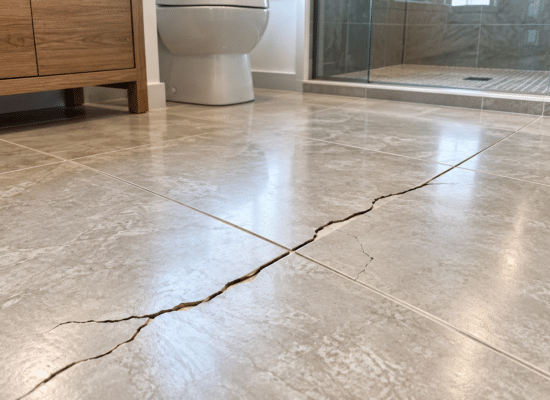
A narrow, stable crack and a displaced crack are not the same problem.
If both sides remain at the same elevation and there are no other warning signs, repair may be straightforward.
If one side has moved vertically, the crack continues widening, or multiple structural warning signs are present, flooring should not be your first priority.
Determine why the slab is moving.
Don’t Choose Basement LVP by Thickness Alone
Consumers often compare two boxes and assume the thicker plank must be better.
It isn’t that simple.
Look at the Wear Layer
The wear layer protects the decorative surface from everyday abrasion.
For a lightly used guest basement, the requirements may be different from a recreation room occupied daily by children and pets.
Compare:
- wear-layer specification
- residential warranty
- scratch/stain protection
- exclusions in the warranty
- intended traffic level
Inspect the Locking System
On floating floors, the joints are part of the structural system.
A thick plank with a poor locking mechanism is not automatically superior to a slightly thinner product with well-designed connections.
Look at the Attached Pad
Some SPC products include attached underlayment.
It may help with:
- sound
- minor comfort improvement
- installation convenience
But don’t automatically add another underlayment underneath.
Some manufacturers prohibit additional padding because excessive movement can stress the locking system.
Verify Below-Grade Approval
This one is simple.
If you’re buying flooring for a basement, make sure the manufacturer explicitly permits the product’s intended below-grade installation.
Don’t assume.
SPC vs LVP for a Finished Basement: Choose by Room Use
Instead of asking which flooring wins overall, match the floor to how you’ll actually use the basement.
Basement Family Room
SPC is a strong candidate when you want:
- wood-look flooring
- easy cleaning
- good durability
- resistance to ordinary household spills
If comfort is particularly important, compare attached pads and complete floor assemblies before buying.
Basement Bar
SPC makes considerable sense here.
Dropped ice, drink spills, wet shoes, and heavier furniture favor an easily cleaned resilient surface.
If you’re planning the rest of the room at the same time, coordinate the flooring with your basement bar layout before installation so cabinets, islands, transitions, and finished floor heights are resolved first.
Home Gym
Think carefully.
SPC can handle traffic well, but concentrated impacts from weights are a different issue. A dedicated rubber gym surface may be more appropriate under exercise equipment and free-weight areas.
Our guide on saving money on basement flooring discusses using different materials according to how individual basement zones function rather than forcing one expensive flooring material throughout the entire level. My Next House Project
Guest Bedroom
SPC works, but comfort may matter more here than maximum dent resistance.
A quality rigid-core floor with rugs can provide a good compromise between moisture practicality and residential appearance.
For a legal sleeping space, flooring is only one part of the project. Review our basement bedroom requirements when planning egress, layout, and other basement-bedroom considerations. My Next House Project
Utility or Mechanical Room
Ask whether you need wood-look plank flooring at all.
Sealed or coated concrete can be more practical.
Our basement epoxy flooring guide can help you compare that alternative before extending LVP into every square foot of the basement. My Next House Project
What About Flooding?
This deserves its own section because the term “waterproof flooring” is routinely misunderstood.
Imagine that a water heater releases 30 gallons of water across an SPC floor.
The planks may themselves resist water damage.
That doesn’t mean the flooring assembly is unaffected.
Water may migrate under the floating floor and become trapped between the flooring and concrete. Baseboards, drywall, insulation, furnishings, and other materials can also get wet.
The correct response to a basement with recurring water intrusion is not simply:
Buy waterproof flooring.
It is:
Find out why water is entering the basement.
Potential sources include grading, gutters, downspouts, foundation cracks, groundwater, plumbing failures, window wells, condensation, or drainage problems.
Flooring comes after that investigation.
SPC vs Waterproof LVP: Don’t Let the Labels Confuse You
Here’s another buying trap.
You may see:
- waterproof LVP
- rigid-core vinyl
- SPC vinyl
- luxury vinyl plank
- waterproof vinyl plank
- rigid luxury vinyl
These categories overlap.
SPC is not the opposite of waterproof LVP. An SPC product may itself be sold as waterproof LVP.
For example, MSI categorizes SPC and WPC within rigid-core luxury vinyl flooring, while Shaw currently lists SPC products within its luxury vinyl offerings. MSI Surfaces
Instead of shopping by label, compare the specifications.
Ask the retailer:
- What is the core material?
- Is this product approved below grade?
- What concrete moisture limits apply?
- What slab flatness does the manufacturer require?
- Is underlayment attached?
- Is additional underlayment permitted?
- What is the wear-layer specification?
- What expansion gap is required?
- Can it be installed over my existing floor?
- What conditions void the warranty?
Those questions reveal far more than “Is this waterproof?”
2026 Update: What We Would Change From a 2024 LVP Basement Guide
Our original 2024 guide focused heavily on identifying the best waterproof LVP flooring for basements. That was useful, but homeowners now have a broader range of rigid-core products and increasingly confusing terminology.
The better 2026 approach is less about compiling a “top 10” product list and more about matching construction to basement conditions.
Our previous waterproof LVP basement guide remains useful for understanding the category, but the decision process should now start with four questions: My Next House Project
Is the basement actually dry?
What condition is the concrete in?
How will the room be used?
What does the specific manufacturer permit?
Only then should color, plank width, brand, or price become the deciding factors.
That is a more durable way to choose flooring than relying on a generic “best LVP” ranking.
How Much Should You Spend on Basement Vinyl Flooring?
There is no useful national price that applies to every basement because the flooring itself is only part of the cost.
Your budget can include:
Flooring + waste + demolition + slab preparation + moisture control + underlayment + installation + transitions + trim
A cheaper plank can therefore produce a more expensive finished project.
For example, suppose one product costs less but your slab requires extensive patching, separate underlayment, and professional installation. A more expensive click-lock SPC product with an attached pad may end up closer in total installed price.
Or the opposite may happen.
That’s why our guide to basement flooring costs recommends comparing the complete installed system, not just the shelf price. My Next House Project
Our Practical Decision Rule for SPC vs LVP for Basement Projects
For a typical finished basement over concrete, start by evaluating SPC rigid-core LVP if you want a floating wood-look floor with strong dent resistance and good water resistance.
Consider another LVP construction when:
- floor height is critical
- glue-down installation makes more sense
- the manufacturer has a product specifically suited to your substrate
- you want different acoustic or comfort characteristics
- your installer recommends a system based on verified slab conditions
And choose neither until an active moisture problem is resolved.
That’s the important distinction.
The best basement floor isn’t the one with the strongest waterproof claim. It’s the flooring system that matches the slab, moisture conditions, room use, installation method, and your expectations for comfort and maintenance.
7. Key Takeaways
- SPC is a type of luxury vinyl flooring, so “SPC vs LVP” isn’t technically an apples-to-apples comparison.
- SPC uses a dense rigid composite core and is commonly available as click-lock luxury vinyl plank.
- SPC is often a strong basement choice because of its rigidity, dimensional stability, water resistance, and dent resistance.
- Waterproof planks do not waterproof your basement or prevent moisture from reaching areas underneath the floor.
- Concrete moisture, cracks, and flatness should be evaluated before buying flooring.
- Traditional or glue-down LVP can still be an excellent choice when matched to the correct substrate and installation.
- Never assume thicker flooring is automatically better. Compare the wear layer, core, locking system, backing, warranty, and installation requirements.
- Verify that the exact flooring product is approved for below-grade installation over concrete.
- Compare total installed cost, not simply price per square foot.
- In a basement with recurring seepage or flooding, fix the water problem before installing either SPC or LVP.
8. FAQ Section – People Also Ask
Is SPC or LVP better for a basement?
SPC is itself a type of luxury vinyl flooring. Compared with flexible LVP, rigid-core SPC is often well suited to finished basements because it combines waterproof plank construction with a dense, dimensionally stable core. However, the better choice depends on the concrete slab, moisture conditions, room use, and the manufacturer’s installation requirements.
Is SPC flooring really waterproof?
Many SPC products are marketed and warranted as waterproof flooring. That means the plank itself is designed to resist water damage. It does not mean an SPC installation waterproofs the basement or prevents water from getting underneath a floating floor. Always verify the exact product’s specifications and warranty.
Can SPC flooring be installed directly over basement concrete?
Many SPC products can be installed over concrete, provided the slab meets the manufacturer’s requirements for moisture, flatness, cleanliness, temperature, and structural condition. Do not assume every SPC product has identical installation requirements.
Do I need a moisture barrier under SPC in a basement?
Possibly. Requirements vary substantially among products and concrete conditions. Some manufacturers specify a vapor barrier over concrete; others incorporate particular backing systems or specify different moisture-control methods. Follow the installation instructions for the exact product rather than applying a universal rule.
Is SPC colder than regular LVP in a basement?
SPC can feel firm and cool because its dense core is installed relatively close to the concrete. Attached underlayment can improve comfort somewhat, but homeowners who prioritize warmth should evaluate the complete flooring assembly, including any approved subfloor or insulation system.
Can mold grow under waterproof vinyl plank flooring?
The vinyl itself does not provide the same food source as many organic materials, but moisture trapped beneath flooring can create conditions where microbial growth develops on dust, debris, adhesives, wall materials, or other organic contaminants. Persistent basement moisture should therefore be corrected rather than simply covered with waterproof flooring.
Is SPC good for uneven basement floors?
SPC’s rigid construction does not eliminate the need for a sufficiently flat substrate. Significant low spots and high spots can allow movement or place stress on click-lock joints. Check the manufacturer’s allowable flatness tolerance and prepare the slab accordingly.
What thickness of SPC is best for a basement?
There is no universal ideal thickness. Total plank thickness is only one specification. Compare core construction, wear layer, attached pad, locking system, warranty, below-grade approval, and installation requirements together.
Should I choose SPC or epoxy for a basement floor?
It depends on the room. SPC generally creates a warmer, more residential wood-floor appearance for family rooms, offices, and bedrooms. Epoxy or another suitable concrete finish may make more sense for utility rooms, workshops, and spaces where a finished concrete surface is desirable. Both require attention to moisture conditions before installation.