

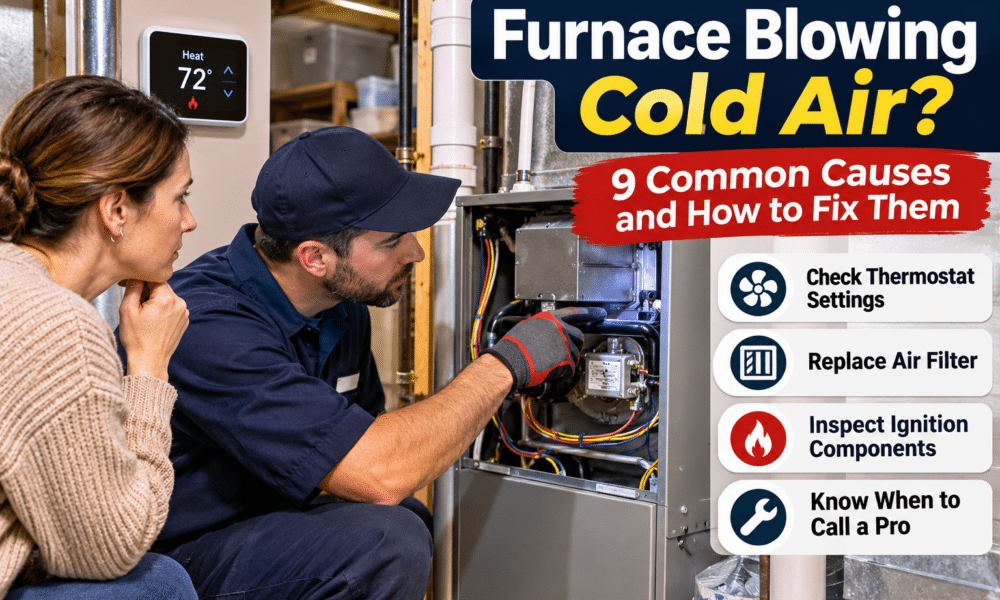
Work through these in order. They’re arranged from easiest and cheapest to hardest and most expensive.
Table Of Content
- 1. The Thermostat Fan Is Set to “ON” Instead of “AUTO”
- DIY difficulty: Easy | Cost: $0
- 2. The Furnace Just Hasn’t Warmed Up Yet
- DIY difficulty: Easy | Cost: $0
- 3. A Dirty or Clogged Air Filter
- DIY difficulty: Easy | Cost: $5 to $35
- 4. A Dirty Flame Sensor
- DIY difficulty: Moderate | Cost: $0 to clean; $80 to $250 for a pro replacement
- 5. A Bad Furnace Igniter or a Pilot Light That’s Out
- DIY difficulty: Moderate | Cost: $15 to $100 for the part; $100 to $250 installed
- 6. Gas Supply Problems
- DIY difficulty: Easy to check; pro to repair | Cost: $675 to $1,300 for a gas valve replacement
- 7. Overheating and a Tripped Limit Switch
- DIY difficulty: Easy to Moderate | Cost: $0 to $300 (blower motor: $250 to $900)
- 8. A Clogged Condensate Line (High-Efficiency Furnaces)
- DIY difficulty: Moderate | Cost: $0 to clear; $75 to $350 for pump replacement
- 9. Leaky Ductwork or a Failing Control Board
- DIY difficulty: Pro | Cost: $500 to $2,000 for ductwork; $300 to $650 for a control board
- Furnace Repair Cost in 2026: Labor & Materials Table
- Furnace Replacement Cost by Brand & Model (2026)
- Our Top Recommendation
- Furnace Prices by Region in the USA
- When to Call an HVAC Technician
- How to Prevent Your Furnace From Blowing Cold Air
- Conclusion
- Frequently Asked Questions
- 1. Why is my furnace blowing cold air when the heat is on?
- 2. Is a furnace blowing cold air dangerous?
- 3. How much does it cost to fix a furnace that won’t heat?
- 4. Can a dirty air filter really make my furnace blow cold air?
- 5. Why does my furnace start warm, then blow cold air?
- 6. Should I repair or replace a 15-year-old furnace?
- 7. How often should I change my furnace filter?
1. The Thermostat Fan Is Set to “ON” Instead of “AUTO”
This is the most common “problem” that isn’t really a problem. When the fan is set to ON, the blower runs nonstop, even between heating cycles, so you feel room-temperature air that seems cold.
The fix:
- Set the fan to AUTO and the system mode to HEAT.
- Set the temperature at least 3 degrees above the current room temperature.
- Swap the thermostat batteries if the screen is dim or blank.
DIY difficulty: Easy | Cost: $0
2. The Furnace Just Hasn’t Warmed Up Yet
A furnace blowing cold air for the first minute or two after it kicks on is usually normal. The air sitting in your ducts cools off between cycles, and the burners need a moment to heat the heat exchanger.
The fix: Wait 3 to 5 minutes. If the air turns warm, you’re fine. If it stays cold, keep going down this list.
DIY difficulty: Easy | Cost: $0
3. A Dirty or Clogged Air Filter
A clogged air filter is one of the biggest winter troublemakers. When air can’t flow freely, the heat exchanger overheats, and a safety device called the high-limit switch shuts the burners off. The blower keeps running to cool things down, and that’s when you feel cold air.
The fix:
- Slide out the filter and hold it up to a light. If you can’t see light through it, replace it.
- Change standard filters every 1 to 3 months (monthly if you have pets).
- Match the size printed on the old filter’s frame.
DIY difficulty: Easy | Cost: $5 to $35
4. A Dirty Flame Sensor
If your burners light, run for a few seconds, then shut off, a dirty flame sensor is a top suspect. This thin metal rod confirms a flame is present. When it’s coated with grime, it can’t “see” the flame, so it cuts the gas as a safety measure.
The fix:
- Turn off power and gas to the furnace.
- Remove the sensor (usually one screw near the burners).
- Gently rub the rod with fine steel wool or an emery cloth, wipe it clean, and reinstall.
DIY difficulty: Moderate | Cost: $0 to clean; $80 to $250 for a pro replacement
5. A Bad Furnace Igniter or a Pilot Light That’s Out
Modern furnaces use a hot-surface furnace igniter that glows bright orange to light the gas. These are fragile and eventually crack. Older furnaces use a standing pilot light that can blow out.
The fix:
- Pilot light: Follow the relighting instructions on the label inside the furnace door.
- Igniter: Watch through the sight glass when the heat calls. No glow, no flame? The igniter likely needs replacing.
DIY difficulty: Moderate | Cost: $15 to $100 for the part; $100 to $250 installed
6. Gas Supply Problems
No fuel means no fire. If you’re dealing with a furnace blowing cold air and none of the steps above helped, check the gas supply.
The fix:
- Make sure the gas valve handle near the furnace runs parallel to the pipe (that means open).
- Test a gas stove burner. If it won’t light either, call your utility.
- Make sure your gas bill is current.
A failing gas valve inside the furnace is a pro-only repair.
DIY difficulty: Easy to check; pro to repair | Cost: $675 to $1,300 for a gas valve replacement
7. Overheating and a Tripped Limit Switch
Even with a clean filter, too little airflow can trip the limit switch. Closed supply vents, furniture blocking return grilles, or a weak blower motor can all cause it.
The fix:
- Open at least 80% of your supply vents.
- Clear rugs, couches, and boxes away from return grilles.
- If the switch keeps tripping, a technician should test it and the blower motor.
DIY difficulty: Easy to Moderate | Cost: $0 to $300 (blower motor: $250 to $900)
8. A Clogged Condensate Line (High-Efficiency Furnaces)
High-efficiency furnaces (90% AFUE and up) produce water as they run. If the drain line or condensate pump clogs, a float switch shuts down the burners to prevent flooding, and you get a furnace not heating while the fan keeps running.
The fix:
- Look for water around the furnace base or a full condensate pump.
- Clear the drain line with a wet/dry vacuum.
- Flush it with a cup of white vinegar to prevent future clogs.
DIY difficulty: Moderate | Cost: $0 to clear; $75 to $350 for pump replacement
9. Leaky Ductwork or a Failing Control Board
If your furnace runs fine but certain rooms stay cold, leaky ducts in an attic or crawl space may be losing heat and pulling in cold air. If the furnace behaves erratically, the control board may be failing. Check the blinking LED light on the board and compare it to the code chart on the furnace door.
The fix: Both are jobs for a licensed HVAC technician.
DIY difficulty: Pro | Cost: $500 to $2,000 for ductwork; $300 to $650 for a control board
Furnace Repair Cost in 2026: Labor & Materials Table
A single repair averages around $300 nationally in 2026, with most bills landing between about $125 and $500. The part that failed drives most of the cost. Here’s what fixing a furnace blowing cold air typically costs:
| Repair | Materials | Labor | Total Installed | DIY-Friendly? |
|---|---|---|---|---|
| Thermostat settings or batteries | $0–$10 | $0 | $0–$10 | ✅ Yes |
| Air filter replacement | $5–$35 | $0 | $5–$35 | ✅ Yes |
| Flame sensor (clean or replace) | $20–$60 | $60–$190 | $80–$250 | ✅ Clean only |
| Furnace igniter | $15–$100 | $85–$150 | $100–$250 | ⚠️ Moderate |
| Condensate pump or drain | $0–$150 | $75–$200 | $75–$350 | ⚠️ Partly |
| Limit or pressure switch | $20–$80 | $80–$270 | $100–$350 | ❌ Pro |
| Control board | $150–$400 | $150–$250 | $300–$650 | ❌ Pro |
| Blower motor | $150–$600 | $100–$300 | $250–$900 | ❌ Pro |
| Gas valve | $300–$700 | $375–$600 | $675–$1,300 | ❌ Pro |
| Ductwork repair or sealing | $100–$800 | $400–$1,200 | $500–$2,000 | ❌ Pro |
| Heat exchanger | $300–$2,000 | $200–$1,500 | $500–$3,500 | ❌ Pro |
Extra fees to expect: A diagnostic or service-call fee usually runs $75 to $200 (often credited toward the repair). Emergency and after-hours labor runs about $140 to $215 per hour.
Furnace Replacement Cost by Brand & Model (2026)
If your furnace is 15+ years old or needs a big repair like a heat exchanger, replacement may be smarter. Use the $5,000 rule: multiply the furnace’s age by the repair cost. If the number is over $5,000, replacement usually makes more sense.
| Brand | Tier | Popular Models | Efficiency (AFUE) | Installed Cost (2026) |
|---|---|---|---|---|
| Goodman | Value | GM9S80, GMVC96 | 80%–96% | $2,800–$5,700 |
| Carrier | Premium | Performance series, Infinity 98 | 80%–98.5% | $3,000–$8,000+ |
| Lennox | Premium | SL297NV, SLP99V | 80%–99% | $3,200–$9,500 |
| Trane | Premium | S9V2, XC95m | 80%–97% | $3,500–$9,500 |
| Any major brand (mid-tier) | Mid | 96% AFUE, two-stage | 96% | $4,000–$6,500 |
By fuel type: Gas furnaces run about $3,500 to $8,500 installed (around $5,500 on average), electric furnaces $2,000 to $5,500, and oil furnaces $5,000 to $10,000.
Our Top Recommendation
For most homeowners, the best value is a 96% AFUE, two-stage or variable-speed gas furnace from a mid-tier or value brand, installed by a highly rated local dealer. Our pick: the Goodman GMVC96. It typically installs for around $4,400, often $1,500 to $2,000 less than a comparable Carrier or Trane, and still comes with a 10-year parts warranty and a lifetime heat exchanger warranty when registered.
Here’s the honest truth: installation quality matters more than the brand name. A perfectly installed Goodman will outperform a poorly installed premium unit. Splurge on a premium modulating furnace (like the Lennox SLP99V or Carrier Infinity 98) only if you live in a very cold climate and plan to stay in your home for 10+ years.
Furnace Prices by Region in the USA
Where you live has a big impact on your bill. Labor rates, permit fees, and climate all play a role. Overall, the Northeast is the most expensive region and the South is the cheapest, with roughly a 16% gap between them.
| Region | vs. National Average | Typical Repair | Gas Furnace Replacement |
|---|---|---|---|
| Northeast (NY, MA, NJ, PA) | +10% to +20% | $330–$600 | $5,500–$9,500 |
| West (CA, WA, OR, CO) | +5% to +15% | $315–$575 | $5,000–$9,000 |
| Midwest (IL, OH, MI, MN) | About average | $300–$500 | $4,500–$8,000 |
| South (TX, FL, GA, NC) | −5% to −15% | $250–$450 | $4,000–$7,000 |
Regional figures are estimates built from national 2026 averages and regional labor adjustments. Big metros like New York City, Boston, and San Francisco often land at the top of these ranges, while smaller towns in the Midwest and South can run 20% to 30% lower. Always get 2 to 3 local quotes.
When to Call an HVAC Technician
DIY is great, but some situations need a pro right away:
- You smell gas or your CO alarm sounds
- The limit switch keeps tripping after you’ve changed the filter
- You see a blinking error code you can’t clear
- You suspect a cracked heat exchanger (soot, rust, or a yellow, flickering flame)
- Any repair involving gas lines, wiring, or the control board
If your furnace blowing cold air survives every fix on this list, that’s your sign to book a technician.
How to Prevent Your Furnace From Blowing Cold Air
A little upkeep goes a long way:
- Schedule a yearly tune-up ($100 to $200) every fall. Techs clean the flame sensor, test the igniter, and inspect the heat exchanger.
- Change your filter every 1 to 3 months.
- Keep vents and returns open and unblocked.
- Flush the condensate line with vinegar each season.
- Consider a smart thermostat that sends alerts when your home isn’t heating.
Conclusion
A furnace blowing cold air is frustrating, but it’s rarely a disaster. Start with the easy stuff: check your thermostat settings, give the furnace a few minutes, and swap the air filter. Next, try cleaning the flame sensor and checking the igniter and gas supply. If those don’t work, it’s time for a pro. Most repairs cost $125 to $500, and if your unit is old and the bill is big, a quality-installed mid-tier furnace is the smartest long-term buy. Stay warm out there!
Frequently Asked Questions
1. Why is my furnace blowing cold air when the heat is on?
The most common causes are a thermostat fan set to “ON,” a clogged air filter, or a dirty flame sensor. Check those three first since they’re quick and cheap to fix.
2. Is a furnace blowing cold air dangerous?
Usually not, because cold air typically means a safety switch has shut off the burners. But if you smell gas or your carbon monoxide alarm sounds, leave the house immediately and call for help.
3. How much does it cost to fix a furnace that won’t heat?
Most furnace repairs cost between $125 and $500, with a national average of about $300 in 2026. Simple fixes like a flame sensor or igniter run $80 to $250, while a heat exchanger can reach $3,500.
4. Can a dirty air filter really make my furnace blow cold air?
Yes. A clogged filter restricts airflow, causing the furnace to overheat. The limit switch then shuts off the burners while the fan keeps blowing unheated air.
5. Why does my furnace start warm, then blow cold air?
This usually points to a dirty flame sensor, a tripped limit switch, or a clogged condensate line on high-efficiency units. Each one shuts the burners down after a short run.
6. Should I repair or replace a 15-year-old furnace?
Use the $5,000 rule: multiply the furnace’s age by the repair cost. If the result tops $5,000, replacement is usually the better investment. Most gas furnaces last 15 to 20 years.
7. How often should I change my furnace filter?
Every 1 to 3 months for standard 1-inch filters. Change it monthly if you have pets, allergies, or a dusty home, and every 6 to 12 months for thick 4- to 5-inch media filters.