

Basement flooring can become expensive surprisingly fast, especially when moisture problems, floor leveling, old adhesive, or demolition enter the picture. The good news is that homeowners can save on basement flooring costs without automatically choosing the cheapest material available. The biggest savings often come from choosing the right flooring for the basement environment, preparing the concrete correctly, limiting unnecessary labor, and avoiding products that may need to be replaced after the first moisture problem. This guide explains where your flooring budget actually goes, which materials offer strong value, what work you may be able to handle yourself, and where spending a little more can prevent a much larger repair later. By following these steps, you can save on basement flooring costs effectively.
Table Of Content
- How to Save on Basement Flooring Costs Before You Buy Anything
- Choose Basement Flooring Based on the Space
- Finished Living Areas
- Utility and Storage Areas
- Basement Gyms and Play Areas
- Compare Installed Cost, Not Just Flooring Price
- Save on Basement Flooring Costs Through Smart Floor Preparation
- Fix High and Low Areas Strategically
- Remove Only What Must Be Removed
- Do Not Ignore Basement Moisture to Save Money
- Consider Luxury Vinyl for Cost-Conscious Finished Basements
- Use Carpet Strategically Instead of Wall-to-Wall Everywhere
- Decide Carefully What to DIY
- Buy Enough Flooring, but Avoid Excessive Waste
- Keep the Flooring Layout Simple
- Shop by Performance Requirements, Not Brand Name Alone
- Avoid Changing Flooring After the Basement Design Is Finalized
- Where You Should Spend More
- Moisture Management
- Subfloor Preparation
- Stairs and Transitions
- Appropriate Materials
- A Practical Basement Flooring Budget Strategy
- 1. Inspect First
- 2. Match Material to Room Use
- 3. Compare Complete Installed Prices
- 4. DIY Selectively
- 5. Protect Against Future Replacement
- What is the cheapest way to finish a basement floor?
- What type of basement flooring gives the best value?
- Can I install new flooring directly over basement concrete?
- Is it cheaper to install basement flooring yourself?
- Should I waterproof my basement before installing flooring?
- How can I reduce basement flooring installation labor costs?
- Is expensive basement flooring worth the money?
How to Save on Basement Flooring Costs Before You Buy Anything
To maximize your budget and save on basement flooring costs, consider these strategies before you buy anything.
The easiest way to overspend on basement flooring is to start shopping before understanding the condition of the floor.
Understanding how to save on basement flooring costs begins with knowing the specific needs of your space.
Basements are different from bedrooms, living rooms, and other above-grade spaces. A concrete slab may look perfectly usable while still transmitting moisture. It can also contain low spots, cracks, old coatings, adhesive residue, or uneven transitions that affect installation.
Before comparing flooring prices, inspect four things:
- moisture conditions
- floor flatness
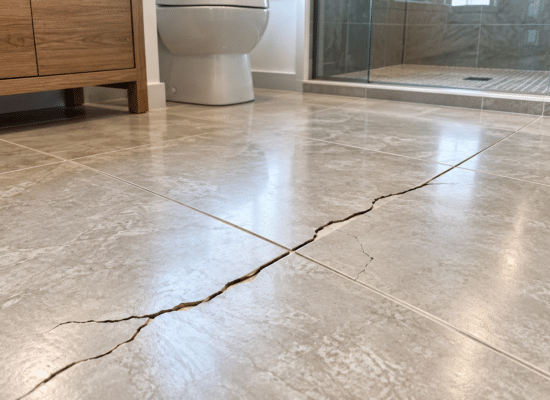
- cracks or damaged concrete
- existing flooring and removal requirements
A lower-priced flooring product does not necessarily produce a lower-priced project. If it requires extensive underlayment, adhesive, moisture mitigation, or professional installation, its total installed cost can exceed a more expensive material with simpler installation requirements.
Think in terms of total project cost, not price per square foot.
Choose Basement Flooring Based on the Space
Choosing the right materials can help you save on basement flooring costs in the long run.
One of the best ways to save money is to avoid installing more flooring than the room actually requires.
A finished basement family room has different needs from a utility room, home gym, guest bedroom, or laundry area.
Finished Living Areas
For recreation rooms, offices, and finished family spaces, homeowners often want warmth and a residential appearance.
Common choices include:
- luxury vinyl plank
- luxury vinyl tile
- engineered flooring approved for below-grade installations
- carpet tile
- certain floating laminate systems designed for suitable basement conditions
Luxury vinyl is particularly attractive for many basements because it combines a finished appearance with relatively straightforward installation. However, individual products have different subfloor and moisture requirements, so the manufacturer’s installation instructions matter.
Utility and Storage Areas
A utility room does not necessarily need premium plank flooring.
Sealed or coated concrete may be sufficient for:
- mechanical rooms
- workshops
- storage rooms
- unfinished basement sections
Using premium flooring only where it adds functional or visual value can reduce material and labor expenses substantially.
Basement Gyms and Play Areas
Rubber tiles, modular flooring, or other resilient surfaces may make more sense than extending expensive decorative flooring throughout these spaces.
Matching every basement room is convenient, but it is not always economical.
Compare Installed Cost, Not Just Flooring Price
A common basement remodeling mistake is comparing products using shelf price alone.
Suppose Flooring A costs less per square foot than Flooring B. Flooring A may still require:
- separate underlayment
- floor leveling
- adhesive
- additional moisture protection
- professional installation
- more complicated cutting and fitting
Flooring B might use a floating installation system and require fewer additional materials.
The useful calculation is:
Flooring + preparation + underlayment + installation materials + labor + trim + waste + demolition
That number provides a much more realistic comparison.
When requesting contractor estimates, ask for these items separately when possible. An itemized estimate makes it easier to identify where meaningful savings exist.
Save on Basement Flooring Costs Through Smart Floor Preparation
Proper floor preparation is essential to save on basement flooring costs and avoid future issues.
Floor preparation is one area where homeowners frequently underestimate the budget.
Unfortunately, it is also one of the worst places to cut corners.
Fix High and Low Areas Strategically
A basement slab does not always need to look cosmetically perfect. It does, however, need to satisfy the flooring manufacturer’s requirements for flatness.
That distinction matters.
Paying to completely resurface a floor when localized grinding or patching would be sufficient can add unnecessary expense. On the other hand, installing floating flooring over serious irregularities may lead to movement, separated joints, noise, or premature damage.
Have the floor evaluated before assuming a full resurfacing job is necessary.
Remove Only What Must Be Removed
Existing basement flooring can influence the project significantly.
Depending on the material, condition, installation method, and new flooring requirements, installation over an existing surface may sometimes be possible.
In other situations, removal is unavoidable.
In some cases, you may even save on basement flooring costs by installing over existing material.
Before scheduling demolition, determine:
- whether the existing floor is securely attached
- whether it is flat enough
- whether moisture is trapped beneath it
- whether the new flooring manufacturer permits installation over that surface
Skipping unnecessary demolition saves labor, disposal fees, and time.
Do Not Ignore Basement Moisture to Save Money
Ignoring moisture can lead to unnecessary expenses; therefore, knowing how to save on basement flooring costs starts with addressing these issues.
There is cheap, and there is economical. They are not the same thing.
Installing flooring over an unresolved moisture problem may produce a lower invoice today and a much larger bill later.
Potential warning signs include:
- visible water staining
- damp concrete
- musty odors
- recurring efflorescence
- previous flooding
- peeling floor coatings
- moisture around slab cracks or foundation walls
The source should be investigated before installing a finished floor.
Problems may involve plumbing, exterior drainage, foundation conditions, groundwater, condensation, or humidity. The appropriate solution depends on the cause.
Spending money on flooring before identifying the moisture source is usually poor budget management.
Consider Luxury Vinyl for Cost-Conscious Finished Basements
Luxury vinyl can help homeowners save on basement flooring costs without sacrificing style.
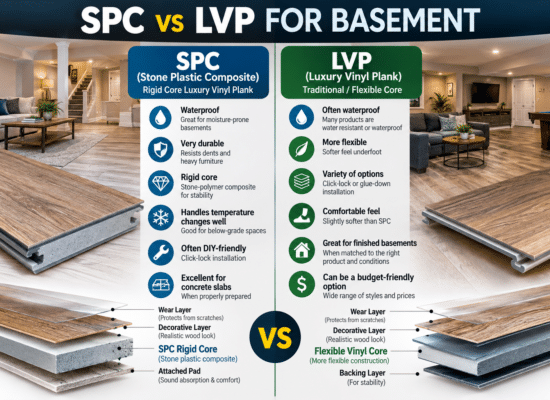
For many homeowners balancing appearance, durability, and installation cost, luxury vinyl plank or tile deserves consideration.
Potential advantages include:
- broad style selection
- floating installation options
- relatively easy plank replacement
- resistance to everyday spills
- compatibility with many basement designs
That does not make every vinyl floor automatically suitable for every basement.
Read the product specifications carefully. Pay attention to approved substrates, moisture limitations, required vapor-control layers, floor-flatness tolerances, and installation instructions.
A bargain product that does not fit the installation conditions is not a bargain.
Use Carpet Strategically Instead of Wall-to-Wall Everywhere
Using carpet strategically can also help you save on basement flooring costs in certain areas.
Carpet creates a warmer basement atmosphere, but traditional wall-to-wall carpet may not be the best choice for every basement.
One budget-conscious alternative is carpet tile.
If individual sections become damaged, replacement may be easier than replacing an entire carpeted room. Carpet tiles can also work well for offices, media areas, and recreation rooms where warmth matters.
Another option is combining a hard-surface floor with a large area rug.
That approach gives the basement a softer feel while maintaining flexibility if moisture or staining becomes a concern.
Decide Carefully What to DIY
Labor can represent a meaningful part of a flooring budget, making DIY installation tempting.
Some homeowners can successfully handle portions of the job, especially with click-lock flooring systems.
Understanding where you can save on basement flooring costs by doing some work yourself is crucial.
Potential DIY tasks include:
- removing simple floating flooring
- moving furniture
- pulling baseboards carefully
- basic cleanup
- installing certain click-lock products
- painting or replacing trim
More technical work may justify professional help.
Examples include:
- significant concrete leveling
- moisture remediation
- complicated transitions
- large-scale adhesive removal
- structural crack evaluation
- installations requiring specialized tools
A useful compromise is a hybrid approach: handle straightforward demolition, cleanup, or finishing work yourself while hiring a flooring professional for substrate preparation and installation.
Buy Enough Flooring, but Avoid Excessive Waste
Planning carefully can help save on basement flooring costs by minimizing waste.
Ordering too little flooring can create delays. Ordering far too much wastes money.
Most projects require additional material beyond the exact measured floor area because cuts, damaged pieces, room geometry, and pattern placement create waste.
However, the appropriate allowance varies.
A rectangular basement with relatively few obstacles may need less extra material than a basement with:
- multiple closets
- angled walls
- columns
- small rooms
- complex plank layouts
Measure carefully before ordering.
Also consider keeping a small amount of matching material after installation. Flooring styles, colors, and product lines can be discontinued, making future repairs difficult.
Keep the Flooring Layout Simple
Keeping the layout simple is an effective way to save on basement flooring costs and reduce installation labor.
Installation complexity directly affects labor.
A straightforward plank layout typically requires less cutting and planning than decorative arrangements such as:
- herringbone
- diagonal installations
- mixed-width patterns
- elaborate borders
If controlling costs is a priority, simple layouts usually provide better value.
They also tend to create less material waste.
You can still add visual interest through furnishings, rugs, wall treatments, lighting, or accent areas rather than placing the entire design burden on the floor.

Shop by Performance Requirements, Not Brand Name Alone
Understanding performance requirements can help you save on basement flooring costs without compromising quality.
Homeowners frequently move toward either extreme: buying the cheapest flooring available or assuming the most expensive product must be the safest option.
Neither approach is particularly reliable.
Compare products according to the features your basement actually needs.
Look at:
- approved installation location
- wear layer or surface durability
- substrate requirements
- warranty conditions
- installation method
- moisture-related limitations
- underlayment requirements
- replacement availability
A midrange product with appropriate specifications can be a better value than either a bargain floor with limitations or a premium product whose extra features provide little benefit in your space.
Avoid Changing Flooring After the Basement Design Is Finalized
Flooring decisions affect more than the floor.
They can change:
- finished floor height
- door clearances
- stair transitions
- baseboard placement
- cabinetry clearances
- transitions into adjoining rooms
Changing materials late in a basement remodeling project can therefore create secondary expenses.
Choose the flooring early enough that its thickness and installation requirements can be incorporated into the overall basement plan.
Where You Should Spend More
In some cases, investing in moisture management can ultimately help you save on basement flooring costs.
Saving money does not mean reducing every line item.
A few areas deserve particular attention.
Moisture Management
If there is evidence of water intrusion or excessive slab moisture, resolve the underlying issue before installing finished flooring.
Subfloor Preparation
Poor preparation can undermine even high-quality flooring.
Stairs and Transitions
Improvised transitions can create trip hazards and make an otherwise polished basement look unfinished.
Appropriate Materials
The lowest-priced floor is expensive if it has to be removed and installed twice.
The objective should be lowest sensible lifecycle cost, not simply the lowest initial invoice.
A Practical Basement Flooring Budget Strategy
Prioritizing decisions that help save on basement flooring costs can lead to a more successful project.
For homeowners trying to control spending, the process can be simplified into five decisions.
1. Inspect First
Understand moisture, concrete condition, and existing flooring.
2. Match Material to Room Use
Do not automatically install the same premium floor in living areas, storage rooms, and utility spaces.
3. Compare Complete Installed Prices
Include flooring, preparation, underlayment, trim, demolition, waste, and labor.
4. DIY Selectively
Take on tasks that match your skills without assuming complicated substrate work is easy.
5. Protect Against Future Replacement
A basement floor that survives the environment is usually less expensive over time than one chosen purely because of its purchase price.
Remember, a basement floor that lasts will help you save on basement flooring costs over time.
7. Key Takeaways
- To save on basement flooring costs, start with the condition of the concrete rather than the flooring showroom.
- Compare total installed costs instead of material prices alone.
- Use premium flooring where comfort and appearance matter most, and simpler materials in utility or storage areas.
- Never cover an unresolved moisture problem simply to reduce the initial budget.
- Luxury vinyl, carpet tile, coated concrete, and other materials can each be cost-effective in the right basement application.
- Simple layouts usually reduce installation labor and material waste.
- DIY demolition and finishing work may save money, while complicated moisture or substrate problems are often better handled professionally.
- The most economical basement floor is one that fits the environment and does not require premature replacement.
8. FAQ Section – People Also Ask
To further save on basement flooring costs, be proactive in preventing moisture-related issues.
What is the cheapest way to finish a basement floor?
Finishing or coating the existing concrete can be one of the least material-intensive approaches when the slab is in acceptable condition. However, cracks, moisture, coatings, and surface preparation can affect the final cost. For finished living areas, homeowners may prefer vinyl, carpet tile, or another material that provides more comfort.
What type of basement flooring gives the best value?
Understanding the value of various flooring options can help you save on basement flooring costs in the long run.
There is no single best flooring for every basement. Luxury vinyl is popular for finished spaces because it offers a residential appearance and relatively straightforward installation, while coated concrete may provide better value in workshops or utility areas. The best value depends on moisture conditions, room use, preparation requirements, and expected durability.
Can I install new flooring directly over basement concrete?
Many flooring systems can be installed over concrete when the slab satisfies the manufacturer’s requirements. The concrete generally needs to be properly prepared, sufficiently flat, and suitable for the specified installation system. Moisture conditions also need to be considered.
Is it cheaper to install basement flooring yourself?
DIY installation can reduce labor expenses when the product and subfloor conditions are suitable. Click-lock flooring is generally more approachable than installations requiring adhesive or extensive concrete preparation. Homeowners should factor in tool costs, waste, time, and the consequences of installation mistakes before deciding.
Should I waterproof my basement before installing flooring?
Any known water intrusion problem should be investigated before installing finished flooring. The appropriate solution depends on whether the moisture comes from plumbing, drainage, groundwater, foundation conditions, condensation, or another source. Flooring alone should not be treated as a waterproofing solution.
Addressing moisture issues early ensures you save on basement flooring costs later.
How can I reduce basement flooring installation labor costs?
Simplifying the layout, clearing furniture before installers arrive, handling appropriate demolition yourself, minimizing complicated transitions, and ensuring flooring selections are finalized before construction can all help control labor. Ask contractors which preparatory tasks homeowners may safely complete without affecting the installation or warranty.
Is expensive basement flooring worth the money?
Sometimes, but not automatically. Paying more makes sense when the product provides useful durability, installation characteristics, or performance appropriate for the basement. Premium finishes that do not provide practical benefits may offer little return. Compare specifications rather than judging quality by price alone.