
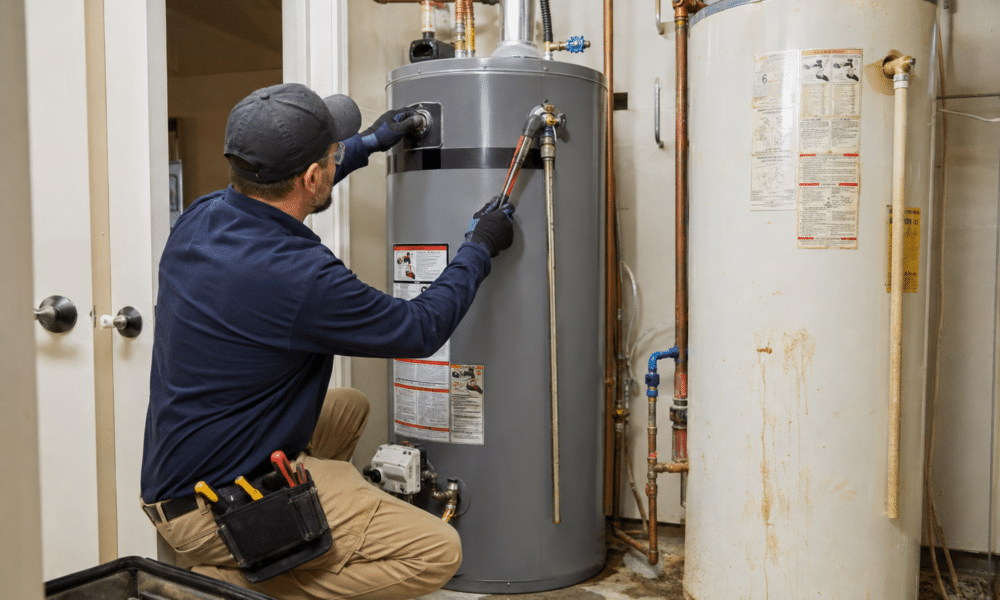
Few household problems are as irritating as stepping into a hot shower only to have the water turn lukewarm a few minutes later. If your hot water runs out quickly, the problem does not automatically mean you need a new water heater. A thermostat setting, sediment buildup, failed heating element, broken dip tube, high household demand, or simply an undersized tank can all reduce how much usable hot water you get. If you often experience that hot water runs out quickly, it’s essential to identify the cause.
Table Of Content
- Why Does My Hot Water Run Out So Quickly?
- 1. Your Household Is Using More Hot Water Than the Tank Can Supply
- Look for a change in usage
- What you can do
- 2. Sediment Has Built Up Inside the Water Heater
- Signs sediment may be involved
- 3. One Heating Element Has Failed in an Electric Water Heater
- Typical symptoms
- 4. The Water-Heater Thermostat Is Set Too Low
- A useful clue
- 5. The Dip Tube May Be Damaged
- When to suspect a dip-tube problem
- 6. Your Gas Water Heater Is Not Heating the Full Tank Properly
- Warning signs
- 7. Your Water Heater May Be Too Small for the House
- Signs the tank may simply be undersized
- 8. An Aging Water Heater May Be Losing Performance
- Repair or replace?
- 9. A Plumbing Crossover May Be Mixing Cold Water Into the Hot Line
- A clue that the problem may be elsewhere
- 10. A Tankless Water Heater Can Also Run Out of Hot Water
- Common tankless problems include
- How to Troubleshoot When Hot Water Runs Out Quickly
- Step 1: Determine whether the problem affects the whole house
- Step 2: Note how long the hot water actually lasts
- Step 3: Check whether the problem is new
- Step 4: Check for unusual noises
- Step 5: Look for water around the heater
- Step 6: Consider simultaneous demand
- Quick Symptom Guide
- How Long Should Hot Water Last in a Shower?
- Can a Showerhead Make Hot Water Run Out Faster?
- Should You Flush the Water Heater?
- When Is It Better to Replace the Water Heater?
- When to Call a Plumber or Water-Heater Technician
- Preventing Hot-Water Problems
- Periodically inspect the heater
- Follow manufacturer maintenance recommendations
- Pay attention when performance changes
- Size replacement equipment around actual household demand
- 7. Key Takeaways
- 8. FAQ – People Also Ask
- Why does my hot water run out after only 10 minutes?
- Why do I suddenly have less hot water than before?
- Can sediment cause hot water to run out faster?
- How can I tell if a water-heater element is bad?
- Why does my shower run out of hot water but my sinks do not?
- Will turning up my water heater make hot water last longer?
- Should I replace my water heater if hot water keeps running out?
- Why does my tankless water heater become cold during a shower?
The right fix depends on whether you have a gas, electric, or tankless water heater and whether the problem appeared suddenly or gradually. This guide explains the most likely causes, what homeowners can safely check, and when repair or replacement makes more sense.
Understanding why your hot water runs out quickly can help you pinpoint the issue faster. Many households face challenges with water heater performance, leading to frustrating experiences.
Why Does My Hot Water Run Out So Quickly?
If you notice that your hot water runs out quickly, it might be time to take action before it becomes a more significant issue.
A conventional storage water heater works by heating a fixed quantity of water and keeping it ready for use. As you shower, wash dishes, or run a washing machine, hot water leaves the tank and cold water replaces it.
The heater then needs time to bring that new water back to temperature.
That means every water heater has limits.
However, if a shower that once stayed hot for 20 minutes suddenly turns cold after five or ten, something has probably changed.
The most common explanations include:
- Increased hot-water use
- Sediment collecting inside the tank
- Increased demand for hot water can lead to situations where your hot water runs out quickly.
- A failed electric heating element
- Incorrect thermostat settings
- A damaged dip tube
- Burner or gas-control problems
- An aging water heater
- A tank that is too small for the household
- Plumbing crossover between hot and cold lines
- Problems with a tankless water heater
Start with the simplest possibilities before assuming the entire unit has failed.
1. Your Household Is Using More Hot Water Than the Tank Can Supply
Sometimes the water heater is functioning correctly. The household is simply asking it to produce more hot water than it can store.
Consider what happens during a busy morning:
- One person showers.
- Someone starts another shower.
- The dishwasher is running.
- A washing machine is using warm or hot water.
A storage tank cannot provide unlimited hot water.
Look for a change in usage
Ask yourself whether anything recently changed.
Perhaps:
- More people are living in the house.
- Family members are taking longer showers.
- A new high-flow showerhead was installed.
- Laundry is being washed with hotter settings.
- Multiple fixtures are being used simultaneously.
If the water stays hot when only one fixture is operating but disappears during periods of heavy use, capacity may be the main issue.
What you can do
By making simple adjustments, you may find that your hot water runs out quickly is no longer a common occurrence.
Try staggering high-demand activities.
For example, avoid running the dishwasher while two people are showering.
If your household regularly exceeds the tank’s capacity, however, behavioral changes may only be a temporary solution. A larger storage tank or properly sized tankless system may be worth considering.
2. Sediment Has Built Up Inside the Water Heater
If you discover sediment buildup, it may explain why hot water runs out quickly and how to resolve it.
Sediment accumulation is one of the most common reasons an older tank-style water heater delivers less hot water than it once did.
Minerals naturally present in water can settle at the bottom of the tank over time.
As that layer becomes thicker, it can:
- Reduce usable tank capacity
- Interfere with heat transfer
- Make the heater work harder
- Contribute to popping or rumbling sounds
Imagine a nominal 50-gallon tank that has accumulated a substantial layer of mineral deposits. The label still says 50 gallons, but some of that internal volume is no longer effectively available for water storage.
Signs sediment may be involved
Watch for:
- Hot water gradually running out sooner
- Popping or rumbling noises
- Cloudy water
- Reduced heater efficiency
- An older unit that has not been periodically maintained
Flushing the tank may help when sediment accumulation is moderate.
However, aggressive flushing of a severely neglected or deteriorated old tank can sometimes expose existing weaknesses. If the heater is already leaking or heavily corroded, have it evaluated before attempting extensive maintenance.
3. One Heating Element Has Failed in an Electric Water Heater
Electric tank water heaters commonly use two heating elements.
The upper element helps heat water near the top of the tank, while the lower element heats a much larger portion of the stored water.
If one element fails, you may still get hot water.
Just not very much of it.
This makes a failed heating element particularly confusing because the water heater does not appear completely broken.
Identifying the signs that your hot water runs out quickly can help you act sooner rather than later.
Typical symptoms
You may notice:
- Hot water starts normally but disappears quickly
- Recovery takes unusually long
- Water never becomes as hot as before
- Performance varies from one day to another
A technician can test the elements and thermostats with appropriate electrical diagnostic equipment.
Replacing an individual element is often far less disruptive than replacing an otherwise serviceable water heater.
Because electric water heaters operate on high-voltage circuits, disconnecting power and verifying that the circuit is de-energized is essential before service. Homeowners who are not comfortable working with electrical equipment should leave element testing and replacement to a qualified professional.
4. The Water-Heater Thermostat Is Set Too Low
Before investigating complicated mechanical problems, check the temperature setting.
If someone lowered the thermostat recently, the tank may contain plenty of water but not enough stored heat to sustain long showers.
You may compensate by turning the shower farther toward the hot side. That uses stored hot water more rapidly.
A useful clue
If the water feels less hot throughout the house rather than simply becoming cold unusually quickly, the thermostat deserves attention.
Do not compensate by setting the water heater excessively hot. Higher temperatures increase scalding risk and may also increase energy consumption.
If thermostat settings appear normal but water temperature is inconsistent, the thermostat itself may require testing.
5. The Dip Tube May Be Damaged
Inside many storage water heaters is a component called a dip tube.
Its job is simple but important.
When cold water enters the heater, the dip tube directs it toward the bottom of the tank. The heated water near the top remains available for your faucets and showers.
If the dip tube breaks, cracks, or deteriorates, incoming cold water can mix with hot water near the top of the tank much sooner than intended.
The result?
A shower that starts hot and becomes lukewarm surprisingly fast.
When to suspect a dip-tube problem
A damaged dip tube becomes more plausible when:
- Hot-water capacity drops suddenly
- The burner or heating system appears to operate normally
- The tank still produces genuinely hot water at first
- Other obvious causes have been ruled out
Replacing a dip tube can sometimes restore normal capacity without replacing the whole heater.
6. Your Gas Water Heater Is Not Heating the Full Tank Properly
Gas water heaters depend on proper burner operation and combustion.
If the burner does not stay on long enough or the control system is malfunctioning, the tank may not fully recover after hot water is used.
Possible issues include:
- Burner problems
- Gas-control problems
- Thermocouple or flame-sensing issues on applicable systems
- Venting problems
- Excessive sediment around the bottom of the tank
Warning signs
A gas water heater deserves professional inspection if you notice:
- The burner repeatedly shuts down
- The pilot will not remain lit on applicable models
- Unusual combustion behavior
- Soot around the unit
- Gas odor
- Venting problems
Do not troubleshoot gas-supply or combustion problems by trial and error.
If you smell gas, leave the area and follow your gas utility’s emergency instructions.
7. Your Water Heater May Be Too Small for the House
A perfectly functioning water heater can still perform badly if it is undersized.
This often becomes noticeable after:
- A household grows
- A bathroom is added
- A large soaking tub is installed
- Multiple showers are upgraded
- Occupancy patterns change
Water-heater sizing should consider more than the tank’s gallon rating.
A useful specification is the first-hour rating, which describes approximately how much hot water a storage heater can provide during a high-demand hour under standardized conditions.
A tank with a higher recovery capability can sometimes serve a household better than another tank of similar physical size.
Signs the tank may simply be undersized
Capacity is worth investigating if:
- The heater has always run out quickly
- Nothing appears mechanically wrong
- Hot water returns normally after the heater recovers
- Problems occur primarily when several people use hot water consecutively
In this situation, repeatedly repairing the heater will not solve the fundamental problem.
8. An Aging Water Heater May Be Losing Performance
Water heaters do not necessarily fail overnight.
Performance can decline gradually.
Internal corrosion, sediment accumulation, deteriorating controls, worn heating elements, and general aging can all contribute to shorter hot-water duration.
Repair or replace?
Deciding whether to repair or replace your water heater can depend on whether hot water runs out quickly.
Age alone should not be the only deciding factor.
Consider the complete condition of the unit.
Replacement becomes more reasonable when several problems appear together, such as:
- Tank leakage
- Significant corrosion
- Repeated repair history
- Poor hot-water capacity
- Slow recovery
- Unusual noises
- Increasing maintenance needs
By contrast, a relatively healthy unit with one failed heating element or thermostat may be a good repair candidate.
The practical question is not simply, “How old is the water heater?”
It is:
How much useful life and reliable performance are you getting for the money you are about to spend?
9. A Plumbing Crossover May Be Mixing Cold Water Into the Hot Line
Occasionally, the water heater is not the real culprit.
If cold water begins to mix, it can also make it seem like your hot water runs out quickly.
A failed mixing valve, shower cartridge, or improperly configured plumbing connection can allow cold water to cross into the hot-water piping.
This can make hot water seem to disappear prematurely.
A clue that the problem may be elsewhere
Pay attention to whether the issue affects:
- Every fixture in the house, or
- Only one shower or faucet
If only one shower becomes cold quickly while other fixtures maintain normal hot-water temperatures, investigate that fixture before blaming the water heater.
A worn shower cartridge, for example, may improperly mix hot and cold water.
10. A Tankless Water Heater Can Also Run Out of Hot Water
Technically, a tankless water heater does not “run out” of stored hot water because it heats water on demand.
That does not mean it can meet unlimited demand.
Every tankless unit has a maximum flow capacity.
If several fixtures demand hot water simultaneously, the heater may not be able to raise all that incoming water to the desired temperature.
Common tankless problems include
- Too many fixtures operating simultaneously
- Restricted water flow
- Mineral scale in the heat exchanger
- Dirty inlet screens
- Ignition problems
- Temperature-sensor problems
- Gas-supply limitations
- A unit that was undersized from the beginning
If hot-water performance declines gradually in a tankless system, maintenance and scale buildup deserve particular attention.
If performance has always been inadequate during simultaneous use, sizing may be the underlying issue.
How to Troubleshoot When Hot Water Runs Out Quickly
You do not need to dismantle the heater to gather useful information.
Testing your fixtures can help confirm whether the entire household experiences hot water runs out quickly.
Start with these observations.
Step 1: Determine whether the problem affects the whole house
Test several fixtures.
If every shower and faucet has the same problem, focus on the water heater.
If only one fixture is affected, investigate that fixture first.
Step 2: Note how long the hot water actually lasts
Is it:
- Two minutes?
- Ten minutes?
- Twenty minutes?
A measurable pattern provides far more diagnostic value than simply saying the hot water “doesn’t last.”
Step 3: Check whether the problem is new
If hot-water duration suddenly dropped, suspect a component failure.
If the heater has always struggled, capacity or sizing may be the issue.
Step 4: Check for unusual noises
Popping, rumbling, and crackling from a storage tank may point toward sediment accumulation.
Step 5: Look for water around the heater
A leaking tank changes the repair decision substantially.
Leaks around fittings may sometimes be repairable.
Water escaping through a corroded tank body generally indicates a much more serious problem.
Step 6: Consider simultaneous demand
Repeat the test when no dishwasher, washer, or second shower is operating.
If performance improves dramatically, demand may exceed available capacity.
Quick Symptom Guide
| What You Notice | Possible Cause |
|---|---|
| Hot water starts hot, then quickly becomes cold | Failed element, dip tube problem, low capacity |
| Hot water is only lukewarm everywhere | Thermostat or heating problem |
| Heater makes popping or rumbling noises | Sediment buildup |
| Only one shower has the problem | Shower valve or cartridge issue |
| Problem occurs only when several fixtures run | Heater undersized or demand too high |
| Electric heater suddenly provides less hot water | Possible failed heating element |
| Tankless heater struggles with multiple fixtures | Flow capacity or sizing issue |
| Hot water takes much longer to recover | Heating, burner, element, or sediment problem |
| Water around the tank | Leak requiring prompt investigation |
How Long Should Hot Water Last in a Shower?
There is no universal number because shower duration depends on several variables:
- Tank capacity
- Incoming cold-water temperature
- Water-heater temperature
- Showerhead flow rate
- Amount of cold water mixed at the shower
- Water-heater recovery rate
- Other fixtures using hot water
This is why comparing your system to its previous performance is often more useful than comparing it with another household.
If your shower used to remain hot comfortably and suddenly does not, investigate the change.
If it has always struggled, evaluate the heater’s capacity.
Can a Showerhead Make Hot Water Run Out Faster?
Absolutely.
A higher-flow showerhead uses more water each minute.
That means it also consumes the tank’s stored hot water faster.
For example, replacing a lower-flow showerhead with a significantly higher-flow model can noticeably shorten shower time even though nothing is wrong with the heater.
The reverse is also useful.
Reducing shower flow can extend usable hot-water duration without modifying the water heater.
This can be an inexpensive solution when the existing system is only slightly undersized for household demand.
Should You Flush the Water Heater?
Periodic flushing can help remove loose sediment from many storage water heaters.
However, the appropriate maintenance procedure depends on:
- Heater design
- Age
- Water quality
- Previous maintenance
- Condition of the drain valve
- Manufacturer instructions
A newer, routinely maintained heater is very different from an old tank that has not been drained in many years.
If the unit is heavily corroded, leaking, or in questionable condition, have it inspected before undertaking aggressive maintenance.
When Is It Better to Replace the Water Heater?
Replacement may be the better investment when the problem is no longer isolated.
Consider replacement when:
-
- The tank itself leaks
If your heater frequently fails and hot water runs out quickly, it may be time for a change.
- Corrosion is extensive
- Repairs are becoming frequent
- Hot-water capacity no longer meets household needs
- The heater is seriously undersized
- Several major components are deteriorating
- You are already planning plumbing or mechanical upgrades
A single repairable component failure does not automatically justify replacement.
The goal should be to compare:
repair cost + expected remaining service life
against
replacement cost + improved reliability/capacity
That is a more useful decision framework than replacing a heater solely because it has reached a particular birthday.
When to Call a Plumber or Water-Heater Technician
Call a qualified professional when:
- The tank is leaking
- You smell gas
- A gas burner is operating abnormally
- Electrical components require testing
- The breaker repeatedly trips
- Hot-water capacity suddenly drops without explanation
- You suspect an internal dip-tube problem
- The unit repeatedly shuts down
- Tankless error codes keep returning
- You are uncertain whether repair or replacement makes financial sense
A good service technician should diagnose the cause before recommending replacement.
Ask what failed, whether the component can be repaired, and what condition the rest of the heater is in.
Understanding whether your unit is undersized can help avoid situations where hot water runs out quickly.
Preventing Hot-Water Problems
You cannot eliminate every water-heater failure, but a few habits can improve reliability.
Periodically inspect the heater
Look for:
- Moisture
- Corrosion
- Rust streaks
- Damaged fittings
- Unusual sounds
Finding a small problem early is preferable to discovering it after water reaches the floor.
Follow manufacturer maintenance recommendations
Maintenance requirements differ by heater type.
Storage and tankless heaters are not maintained the same way.
Pay attention when performance changes
A gradual decline in hot-water duration is information.
Do not automatically compensate by continually increasing temperature settings.
Determine why performance changed.
Size replacement equipment around actual household demand
When replacement becomes necessary, do not simply buy whatever tank size was installed previously.
Consider:
- Household size
- Number of bathrooms
- Shower habits
- Large tubs
- Simultaneous fixture use
- Available electrical or gas capacity
- Recovery requirements
The best water heater is not necessarily the largest one. It is the one correctly matched to the house.
7. Key Takeaways
If your hot water runs out quickly, a professional may provide insights on the issue.
- If hot water runs out quickly, the water heater does not necessarily need replacement.
- Heavy simultaneous use can overwhelm an otherwise properly functioning storage heater.
- Sediment buildup can reduce usable tank capacity and heating performance.
- Your hot water runs out quickly if the heater isn’t meeting the family’s demands.
- Electric heaters may continue producing some hot water even when one heating element has failed.
- A damaged dip tube can cause incoming cold water to mix with stored hot water prematurely.
- If only one fixture has the problem, investigate the faucet or shower valve before replacing the heater.
- Tankless water heaters can struggle when demand exceeds their rated flow capacity.
- A leaking, badly corroded, unreliable, or seriously undersized heater may be better replaced than repaired.
- Gas, high-voltage electrical, combustion, and significant leakage problems should be handled by qualified professionals.
8. FAQ – People Also Ask
Why does my hot water run out after only 10 minutes?
A storage water heater may run out quickly because of excessive demand, sediment buildup, a failed electric heating element, a damaged dip tube, an incorrect thermostat setting, or insufficient tank capacity. If the heater previously provided significantly more hot water, a mechanical or maintenance-related problem becomes more likely.
Why do I suddenly have less hot water than before?
A sudden change often points toward a failed component rather than normal household demand. Electric heating elements, thermostats, burner controls, shower mixing valves, and dip tubes are among the possibilities. Start by confirming whether the problem occurs throughout the entire house.
Can sediment cause hot water to run out faster?
Yes. Sediment can accumulate at the bottom of a storage water heater, reducing effective capacity and interfering with heat transfer. Popping or rumbling sounds from the tank can be another clue that mineral buildup is present.
How can I tell if a water-heater element is bad?
One common symptom is having some hot water but substantially less than usual. An electric water heater with one failed element may continue operating, which is why the problem can be easy to overlook. Proper electrical testing is required to confirm an element failure.
Why does my shower run out of hot water but my sinks do not?
To prevent situations where your hot water runs out quickly, keep an eye on the unit’s performance.
If the problem is isolated to one shower, the water heater may be working normally. A worn or malfunctioning shower cartridge or mixing valve could be allowing too much cold water into the shower supply.
Will turning up my water heater make hot water last longer?
Increasing storage temperature can change how much hot water is mixed with cold water at fixtures, but raising temperature excessively creates a scalding hazard and is not a substitute for diagnosing poor water-heater performance. If the temperature setting has not changed and capacity suddenly declined, investigate the underlying cause.
Should I replace my water heater if hot water keeps running out?
If you find that your hot water runs out quickly, consider exploring all potential causes.
Not automatically. First determine whether the problem is caused by demand, sizing, maintenance, or a repairable component. Replacement becomes more compelling when the tank leaks, the heater is heavily corroded, reliability is poor, or capacity no longer fits the household.
Why does my tankless water heater become cold during a shower?
Possible reasons include demand exceeding the heater’s capacity, mineral scale, restricted water flow, ignition problems, sensor issues, or equipment sizing. If temperature problems occur primarily when several hot-water fixtures are running, capacity should be investigated.