
A desk pushed into a spare bedroom corner can look perfectly fine at noon and become a headache by 4 p.m. The right home office lighting ideas solve more than a decorating problem: they can cut screen glare, reduce eye strain, make paperwork easier to read, and help you look more professional on video calls. The goal is not one brighter bulb. It is a layered setup that gives you useful light where you work and comfortable light throughout the room. Here are some additional home office lighting ideas for you to consider.
Table Of Content
- Start With the Work You Actually Do
- Home Office Lighting Ideas for Every Task
- 1. Put Your Desk Beside a Window, Not Directly in Front of It
- 2. Add an Adjustable Task Lamp
- 3. Choose Bulbs in the Right Color Temperature
- 4. Upgrade a Dim Ceiling Fixture
- 5. Use Indirect Light to Soften Screen Contrast
- 6. Light Your Face for Video Calls
- 7. Put Office Lights on Dimmers or Smart Controls
- 8. Add a Floor Lamp to a Dark Corner
- 9. Use Wall Sconces When Desk Space Is Tight
- 10. Add Light Inside Storage and Built-Ins
- 11. Reduce Reflections Before Adding More Light
- 12. Make the Lighting Match the Room’s Second Job
- A Simple Home Office Lighting Plan by Budget
Start With the Work You Actually Do
Home Office Lighting Ideas for Every Task
Before buying fixtures, take stock of how you use the office. A graphic designer editing color-sensitive files has different needs from someone spending most of the day on video calls or reviewing printed contracts. If you share the room with a guest bed, a hobby area, or a child doing homework, flexible lighting matters even more.
Integrating multiple home office lighting ideas into your workspace can significantly enhance productivity and comfort.
The most dependable approach combines ambient light for the whole room, task light at the desk, and softer accent light to prevent the space from feeling harsh after dark. You do not need to install every layer at once. Many homeowners can make a meaningful improvement with a better desk lamp, the right bulbs, and a few small changes to window placement.
1. Put Your Desk Beside a Window, Not Directly in Front of It
Daylight is free, pleasant, and useful for keeping a workday from feeling like time spent in a closet. Place the desk perpendicular to a window when possible. This lets daylight reach the work surface from the side without turning your monitor into a mirror.
A desk facing a window can create glare on the screen, while a window directly behind you often causes a webcam to expose your face too dark. If your layout leaves no alternative, use adjustable blinds or light-filtering shades. They soften strong sun without making the room feel closed off.
2. Add an Adjustable Task Lamp
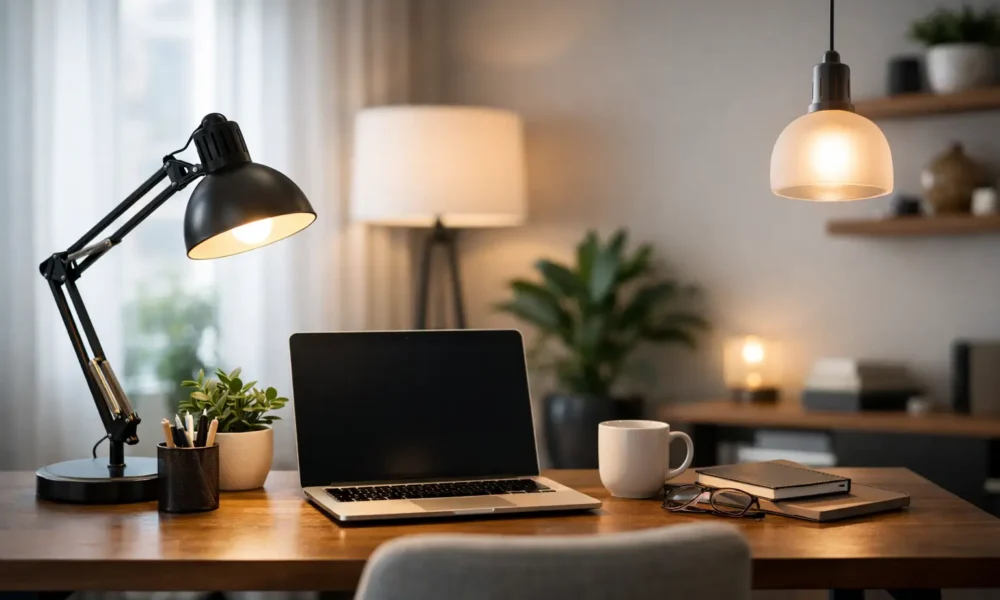
A dedicated desk lamp is one of the highest-value upgrades in a home office. Choose one with an adjustable arm or head so you can aim light at a notebook, keyboard, or document without sending it directly into your eyes.
Exploring various home office lighting ideas can lead to a more enjoyable work environment.
Right-handed writers generally do best with the lamp on the left, while left-handed writers should place it on the right. That simple placement keeps your hand from casting a shadow across the page. Look for a lamp with a diffuser or frosted shade, especially if you work close to it for hours.
For a typical desk, an LED task lamp in the 800- to 1,100-lumen range is usually enough for focused work. Models with dimming controls cost more than basic lamps, but they make the office far more adaptable from morning through evening.
3. Choose Bulbs in the Right Color Temperature
Bulb color is often the reason a room feels either alert and clean or strangely yellow and sleepy. For most home offices, LEDs around 3,500K to 4,000K offer a practical middle ground. They provide a neutral to cool white light that supports concentration without the blue-heavy look of very cool commercial lighting.
Warmer 2,700K bulbs can work well in an office that also serves as a den or guest room, particularly in table lamps used at night. For detail work, though, they may feel too dim or golden. Avoid mixing dramatically different bulb colors in fixtures you use at the same time. A warm floor lamp beside a stark-cool ceiling fixture can make both the room and your skin tone look off.
Consider these home office lighting ideas when selecting your bulbs.
4. Upgrade a Dim Ceiling Fixture
A single flush-mount fixture with a weak bulb is common in converted bedrooms and builder-basic offices. It may technically light the room, but it can leave desk corners dark and force you to rely on a glaring task lamp.
Replacing the fixture is a manageable homeowner project if the existing electrical box is secure and you are comfortable shutting off power and following the fixture instructions. A semi-flush mount, a low-profile LED fixture, or a small ceiling fan with an integrated light can provide better overall coverage. If the wiring is old, the box is loose, or you need to add a new ceiling location, bring in a licensed electrician.
For an average 100- to 150-square-foot office, aim for roughly 1,500 to 3,000 total lumens of ambient light, then add task lighting at the desk. The lower end works for bright rooms with good windows. Windowless offices or rooms with dark paint, floors, and furniture often need more.
5. Use Indirect Light to Soften Screen Contrast
Using indirect light is among the best home office lighting ideas to soften screen contrast.
A bright monitor in an otherwise dark room makes your eyes work harder because they are constantly adjusting between extremes. A small lamp behind the monitor, a floor lamp bounced off a wall, or LED strip lighting mounted behind the desk can provide gentle background illumination.
This is sometimes called bias lighting, but it does not need to be a specialty product. The key is to keep the light indirect and low enough that it does not reflect in the screen. Choose white light rather than shifting colors for an office used for regular work. Color-changing strips are fun for gaming, but they can become distracting during a long spreadsheet session.
6. Light Your Face for Video Calls
Effective home office lighting ideas can dramatically improve your video call quality.
Overhead lighting alone creates under-eye shadows and can make a well-organized office look less polished on camera. The simplest fix is a small diffused light placed behind your monitor or slightly to one side of the webcam, aimed toward your face.
A ring light can work, but it is not the only answer. A compact LED panel or a table lamp with a white shade often produces a more natural result. Keep the light near eye level, not high on a shelf. If you wear glasses, move the source farther to the side until reflections disappear from the lenses.
7. Put Office Lights on Dimmers or Smart Controls
Lighting needs change from a bright morning to a late-night deadline. Dimmers let one fixture serve several jobs: full output for cleaning or sorting papers, medium light for regular work, and a lower setting for winding down.
A dimmer switch is usually inexpensive, but compatibility matters. The switch, the fixture, and the LED bulbs should all be rated for dimming. Otherwise, you may get flickering, buzzing, or a bulb that drops out before it dims very far. Smart bulbs and plug-in smart plugs are a renter-friendly alternative when you do not want to change wiring.
8. Add a Floor Lamp to a Dark Corner
This is one of the simplest home office lighting ideas to implement.
A floor lamp is an easy way to make a small office feel intentional rather than temporary. An uplight torchiere can brighten the ceiling and spread light around the room, while a shaded floor lamp adds warmer, softer illumination beside a reading chair or filing cabinet.
Avoid placing a bare-bulb floor lamp in the direct line of sight from your chair. It may deliver plenty of lumens but still feel uncomfortable. A lamp with an upward-facing bowl, opaque shade, or adjustable reading arm is usually more useful.
9. Use Wall Sconces When Desk Space Is Tight
In compact offices, a desk lamp can consume valuable real estate. Plug-in wall sconces offer a practical alternative, especially beside a built-in desk or in a nook where there is no room for a floor lamp. Swing-arm styles can pull closer for reading and fold back when you need a clearer surface.
Hardwired sconces create the cleanest look, but they add electrician and drywall-repair costs. Plug-in models are less expensive and easier to install, though the cord needs thoughtful routing. Use a paintable cord cover when the outlet location makes the cable too visible.
10. Add Light Inside Storage and Built-Ins
Incorporating lights into storage is one of the lesser-known home office lighting ideas.
File cabinets, deep shelves, and closed storage often become black holes for supplies. Battery-powered puck lights or rechargeable motion-sensor bars make a surprising difference inside a cabinet, closet, or built-in workstation. They are especially helpful in offices where printer paper, records, and tech accessories live behind closed doors.
This is a small project, but choose rechargeable lights with a simple magnetic mount. Replacing disposable batteries in several fixtures quickly becomes a nuisance.
11. Reduce Reflections Before Adding More Light
More light is not always the answer. A glossy desktop, glass-framed artwork, shiny white cabinets, or a monitor facing a window can bounce light exactly where you do not want it. Before buying another fixture, move the monitor, angle the screen slightly downward, and test different shade positions.
Matte finishes help, too. A desk pad can reduce glare from a reflective work surface while making the desk more comfortable for writing. If afternoon sun is the issue, a solar shade can be a better investment than a stronger lamp.
12. Make the Lighting Match the Room’s Second Job
This can enhance your overall design, as home office lighting ideas significantly impact aesthetics.
Many home offices have to work overtime as guest rooms, craft rooms, or family command centers. In those spaces, separate controls are worth planning. You may want bright neutral light at the desk but warm bedside lighting for visitors, or focused work light near a sewing machine with softer room light elsewhere.
A layered plan also keeps your utility costs in check. LEDs use far less energy than older incandescent bulbs, and putting only the lights you need on at a given time is more efficient than flooding the whole room with maximum output.

A Simple Home Office Lighting Plan by Budget
For under $75, start with a dimmable LED desk lamp and replace mismatched bulbs with 3,500K or 4,000K LEDs. For roughly $75 to $250, add a floor lamp or plug-in sconce, a monitor backlight, and a simple video-call light. Larger budgets can support a new ceiling fixture, dimmer controls, hardwired sconces, or electrical work for a room that has never had adequate overhead light.
Do not judge the result only by how the office photographs. Sit down at your desk at the times you normally work, open the documents and programs you use, and notice where your eyes feel strained or shadows get in the way. The best lighting plan is the one that makes the room easier to use every ordinary day, not just brighter when the switch first turns on.
All these home office lighting ideas contribute to a better working experience.