
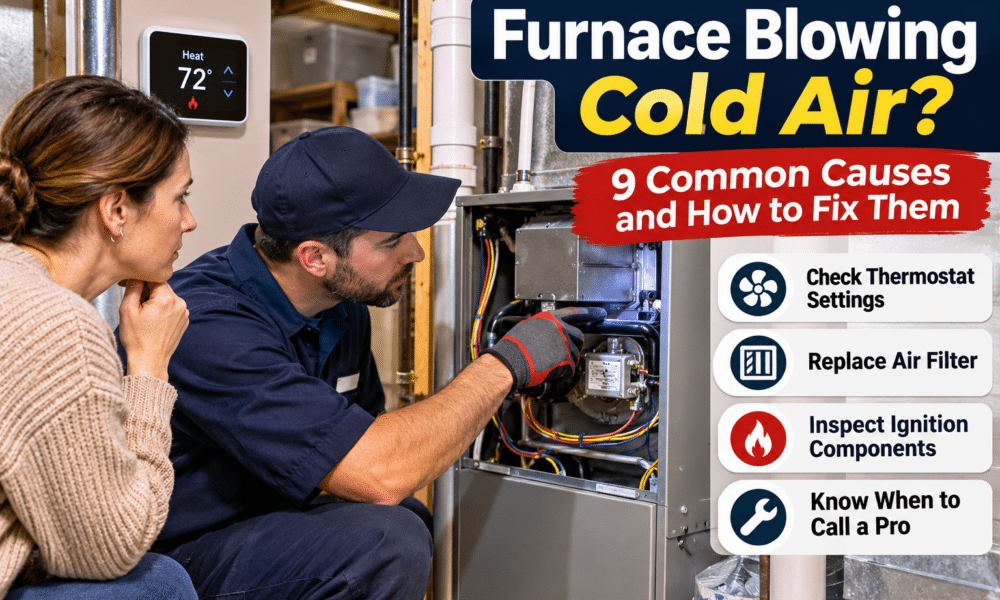
A furnace blowing cold air on a freezing winter morning is the last thing any homeowner wants. You turn up the thermostat, hear the heating system start, and expect warm air. Instead, cold or lukewarm air comes through the vents, and your house never seems to reach a comfortable temperature. If you are experiencing a furnace blowing cold air, it can be frustrating and uncomfortable.
Table Of Content
- Why Is My Furnace Blowing Cold Air?
- Quick Furnace Troubleshooting Chart
- 1. Your Thermostat Fan Is Set to ON Instead of AUTO
- How to Fix It
- 2. Your Furnace Air Filter Is Dirty or Clogged
- Warning Signs of a Clogged Filter
- How to Fix It
- 3. The Furnace Hasn’t Finished Warming Up
- How to Tell If This Is Normal
- 4. A Dirty or Faulty Flame Sensor Is Shutting Down the Burners
- What Should You Do?
- 5. Your Furnace Ignitor Is Not Working
- Common Symptoms
- Recommended Fix
- 6. Your Furnace Is Overheating and Triggering a Safety Switch
- How to Address the Problem
- 7. Closed Air Vents or Leaky Ductwork Are Restricting Heat
- What to Check
- 8. The Furnace Has a Blocked Vent or Pressure-Switch Problem
- Warning Signs
- How to Respond
- 9. A Faulty Control Board or Electrical Component Is Preventing Heat
- Recommended Fix
- Furnace Blowing Cold Air: What to Check Before Calling a Technician
- When to Treat It as an Emergency
- How Much Does Furnace Repair Cost in 2026?
- Estimated Furnace Repair Costs in the USA
- Should You Repair or Replace the Furnace?
- How to Prevent Your Furnace From Blowing Cold Air Again
- Frequently Asked Questions
- 1. Why is my furnace blowing cold air when the heat is on?
- 2. Why is my furnace running but not producing heat?
- 3. Should I turn off my furnace if it’s blowing cold air?
- 4. Can a dirty filter make a furnace blow cold air?
- 5. Why does my furnace blow warm air and then cold air?
- 6. How much does it cost to fix a furnace blowing cold air?
- 7. Can I troubleshoot a furnace blowing cold air myself?
The good news? A furnace that isn’t blowing hot air doesn’t always need an expensive repair. Sometimes the problem is a thermostat setting, a clogged air filter, or blocked vents. Other times, a malfunctioning ignition system, flame sensor, or safety control needs professional attention.
If your heating system is a furnace blowing cold air, it’s essential to understand the possible causes.
Before scheduling an emergency HVAC service call, it helps to understand what your furnace is doing and why.
In this guide, we’ll cover nine common reasons a furnace blows cold air, the checks you can safely perform yourself, typical 2026 repair costs, and the warning signs you shouldn’t ignore.
Experiencing a furnace blowing cold air consistently can signal that it’s time for a deeper inspection.
Why Is My Furnace Blowing Cold Air?
The most common reasons include an incorrect thermostat fan setting, restricted airflow, a failed ignition sequence, or a furnace safety shutdown.
When your furnace is blowing cold air, the most common reasons include an incorrect thermostat fan setting, which is crucial to address promptly.
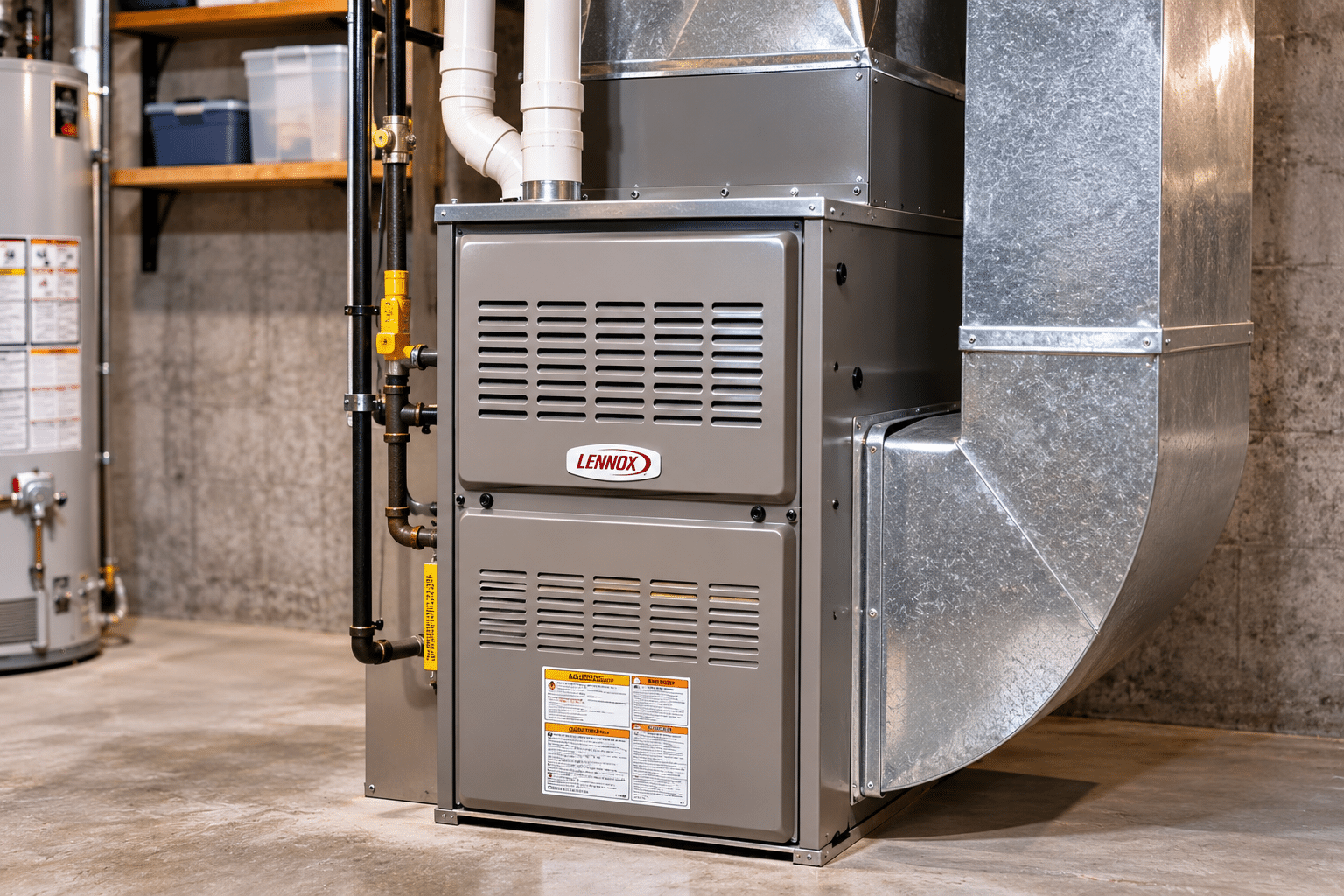
A gas furnace works by burning fuel inside a sealed heating system. The heat exchanger transfers that heat to air circulating through your home’s ductwork. If the burners stop producing heat while the blower continues running, the vents may deliver cool air.
However, not every burst of cooler air indicates a breakdown.
If your furnace is blowing cold air, it might not indicate a significant problem, but it’s always good to check.
For example, some furnaces circulate room-temperature air briefly at the beginning or end of a heating cycle. That’s different from a system that runs continuously without warming your home.
Quick Furnace Troubleshooting Chart
Pay attention to the signs when your furnace is blowing cold air, as they can guide you in troubleshooting.
| What you’re noticing | Possible cause | Recommended action |
|---|---|---|
| Cool air between heating cycles | Fan set to ON | Switch fan to AUTO |
| Weak airflow and poor heating | Dirty furnace filter | Check or replace filter |
| Furnace starts, then stops heating | Overheating or safety shutdown | Check airflow; call HVAC technician if repeated |
| Burners ignite, then shut off quickly | Flame sensor issue | Professional inspection |
| Fan runs, but burners never light | Ignitor or ignition problem | Professional diagnosis |
| Some rooms are cold | Blocked vents or duct problems | Open vents and check obstructions |
| No heat after changing thermostat settings | Thermostat or control issue | Verify settings and system compatibility |
| Furnace repeatedly stops | Venting or pressure-switch problem | Professional service |
| Heating system runs with unusual fault codes | Electrical or control-board failure | Record code and call technician |
This table provides starting points, not a definitive diagnosis. Different furnace models use different control sequences and safety systems.
1. Your Thermostat Fan Is Set to ON Instead of AUTO
One of the simplest reasons for your furnace blowing cold air is a thermostat fan setting.
One of the simplest reasons for a furnace blowing cold air is a thermostat fan setting.
Most thermostats offer two basic fan options:
- ON: The blower operates continuously, even when the furnace isn’t heating.
- AUTO: The blower operates according to the heating system’s normal control cycle.
When the fan is set to ON, room-temperature air can circulate through your vents between heating cycles. In winter, that air may feel surprisingly cold against your skin.
How to Fix It
First, confirm that your thermostat is set to HEAT.
Next, set the fan to AUTO rather than ON. Raise the requested temperature a few degrees above the current room temperature and observe a normal heating cycle.
For programmable or smart thermostats, check for schedules, circulation settings, or unexpected changes to the heating mode.
If your thermostat is outdated or malfunctioning, upgrading may be worth considering. Our Nest Thermostat E installation guide explains common compatibility and installation considerations.
Homeowner tip: If warm air returns during heating cycles and the blower stops between them, the fan setting may have been the entire problem.
2. Your Furnace Air Filter Is Dirty or Clogged
Regular inspections are vital to prevent issues like a furnace blowing cold air due to a dirty filter.
A dirty air filter is another common reason a furnace is running but not heating properly.
Your heating system needs adequate airflow to move heat from the furnace into your living spaces.
When dust, pet hair, and other particles accumulate in the filter, airflow becomes restricted. If the restriction is severe, the furnace may overheat and trigger a high-temperature safety limit.
The burners can shut off while the blower continues operating, resulting in cool air coming from the vents.
Warning Signs of a Clogged Filter
You might notice reduced airflow, unusually long heating cycles, frequent shutdowns, or rooms that never reach the thermostat’s set temperature.
How to Fix It
Turn the system off at the thermostat and follow the manufacturer’s instructions for accessing the filter.
Remove the filter and inspect it for heavy dirt buildup. Replace disposable filters with the correct size and approved type, or clean reusable filters according to their instructions.
Make sure the airflow arrow faces the direction specified for your furnace.
Many standard disposable filters need inspection every month and replacement roughly every one to three months, depending on the filter, system, and household conditions. Follow the manufacturer’s schedule.
Avoid installing a highly restrictive filter without confirming that your equipment can accommodate it.
Important: If the furnace continues overheating or shutting down after replacing the filter, turn it off and arrange professional service.
3. The Furnace Hasn’t Finished Warming Up
Sometimes the problem of a furnace blowing cold air isn’t a problem at all, but rather a normal heating cycle.
Sometimes the problem isn’t a problem at all.
When a heating cycle begins, the furnace needs time to produce heat and bring the heat exchanger up to operating temperature.
Many gas furnaces intentionally delay the blower until sufficient heat is available. Other operating sequences may create a brief period of cooler airflow.
Similarly, some systems continue circulating air after the burners shut off to recover residual heat.
How to Tell If This Is Normal
Observe one complete heating cycle without opening furnace panels.
If the air becomes warm shortly after the burners start and your home reaches its set temperature, the system may be operating normally.
However, if the blower runs continuously with no meaningful heat, something else may be wrong.
Key distinction: A brief cool-air period is different from a furnace that consistently fails to warm your home.
4. A Dirty or Faulty Flame Sensor Is Shutting Down the Burners
In many cases, a furnace blowing cold air could indicate a malfunctioning flame sensor.
In many modern gas furnaces, the flame sensor is an essential safety component.
Its job is to verify that the burner flame is present when the gas valve is open.
If the control system cannot verify the flame, it shuts off the gas supply to prevent an unsafe operating condition.
Over time, deposits or component deterioration can interfere with flame detection.
A typical symptom is a furnace that ignites, operates for several seconds, and then shuts off the burners while the blower continues running.
What Should You Do?
Check whether your thermostat displays an error notification or whether an accessible diagnostic display shows a fault code.
Record the code and consult the manufacturer’s instructions.
Although some online guides recommend cleaning flame sensors yourself, burner compartments contain electrical and fuel-burning components. For most homeowners, professional diagnosis is the safer choice.
A technician can test the flame-sensing circuit, confirm the ignition sequence, and determine whether cleaning or replacement is appropriate.
5. Your Furnace Ignitor Is Not Working
If your gas furnace fan runs but the heating burners never ignite, the ignition system may have failed.
When faced with a furnace blowing cold air, checking the ignitor becomes essential.
Many contemporary furnaces use an electronic ignitor instead of a continuously burning pilot light.
These components can fail from age, electrical problems, or repeated heating cycles.
When the furnace cannot ignite, its control system may attempt another startup or enter a safety lockout.
Common Symptoms
You may hear the system attempting to start without producing heat. On some models, the blower operates even though the burners never light.
A fault code may identify an ignition-related failure, although additional testing is needed to determine the exact cause.
Recommended Fix
Check the thermostat settings first. If the issue persists, contact an HVAC technician.
Do not attempt to light burners manually, bypass ignition controls, or replace gas-system components without the appropriate qualifications.
A technician can inspect the ignitor, wiring, control signals, and associated safety components.
6. Your Furnace Is Overheating and Triggering a Safety Switch
It may sound contradictory, but overheating can actually cause a furnace to blow cold air.
Overheating can paradoxically lead to a furnace blowing cold air due to safety controls activating.
A furnace contains safety controls designed to stop the burners when temperatures exceed acceptable operating limits.
Restricted airflow is one potential cause.
For example, a dirty filter, blocked return-air opening, or excessive number of closed supply vents may prevent heat from being distributed properly.
When a high-limit control activates, the furnace may shut down its burners and keep the blower running to reduce internal temperatures.
How to Address the Problem
Start by inspecting the air filter and confirming that supply and return vents are unobstructed.
Move furniture, rugs, or other objects away from registers.
If the problem continues, have an HVAC professional inspect the blower, ductwork, temperature rise, and safety controls.
Never bypass or repeatedly reset a furnace safety switch. A recurring high-limit fault can signal a serious operating problem.
7. Closed Air Vents or Leaky Ductwork Are Restricting Heat
Closed air vents can also be a culprit when your furnace blowing cold air is a concern.
If your furnace operates normally but certain rooms remain cold, the issue may be air distribution rather than heat production.
Closing too many supply vents can restrict airflow through a forced-air system. Leaky, disconnected, or poorly insulated ducts can also prevent warm air from reaching the rooms that need it.
This is particularly noticeable in houses with ductwork running through unfinished attics, garages, or crawl spaces.
What to Check
Walk through your home and confirm that supply registers are open and not blocked.
Inspect accessible ductwork from a safe location for obvious disconnected sections or damaged connections. Do not enter unsafe attic or crawl-space areas to investigate.
If one room consistently receives weak or cool airflow while others heat normally, an HVAC professional can evaluate duct leakage, airflow balance, and insulation.
Remember that an uncomfortably cold room may also have air leaks around windows or inadequate insulation.
Our article on smart home trends for 2026 explains why air sealing and insulation should often come before advanced temperature-control upgrades.
8. The Furnace Has a Blocked Vent or Pressure-Switch Problem
High-efficiency gas furnaces rely on a venting system to carry combustion gases safely outdoors.
Many use an inducer motor and pressure switch to verify that the venting system is operating under appropriate conditions.
A blocked intake or exhaust terminal, condensate drainage issue, defective inducer, or pressure-switch fault can prevent a normal heating cycle.
Warning Signs
The furnace may attempt to start repeatedly, display an error code, or fail to ignite despite the thermostat calling for heat.
High-efficiency furnaces may also develop condensate-related problems during freezing weather.
How to Respond
If accessible from ground level, visually check exterior vent terminals for obvious snow, ice, leaves, or debris without disassembling or modifying the venting system.
If a terminal appears blocked, follow the manufacturer’s guidance. Do not run the furnace until the blockage has been safely resolved.
Leave internal pressure switches, vent connections, and combustion testing to qualified technicians.
Never bypass a pressure switch to force the furnace to operate.
9. A Faulty Control Board or Electrical Component Is Preventing Heat
It’s crucial to recognize when a furnace blowing cold air is due to a faulty control board.
Modern furnaces contain electronic controls responsible for coordinating the thermostat, inducer, ignition sequence, burners, blower, and safety switches.
When a control board, relay, wiring connection, or other electrical component malfunctions, the normal heating sequence may be interrupted.
For example, the blower could continue operating even though the burners are not producing heat.
Possible symptoms include intermittent operation, unusual startup behavior, unexplained shutdowns, and diagnostic codes.
Recommended Fix
Start by checking the thermostat and confirming that the furnace has electrical power.
If the system is reporting an error, record it for your HVAC technician.
Avoid opening energized electrical compartments or attempting control-board repairs yourself.
Because several different faults can create similar symptoms, professional testing is important before replacing expensive parts.
Furnace Blowing Cold Air: What to Check Before Calling a Technician
If there is a risk of a furnace blowing cold air, start with basic checks first.
If there is no gas odor, carbon monoxide alarm, smoke, or other immediate safety concern, try these basic checks:
- Check the thermostat. Confirm HEAT mode, a reasonable temperature setting, and fan AUTO.
- Inspect the air filter. Replace a dirty filter using the correct type and size.
- Open the vents. Make sure supply and return registers are not blocked.
- Look for error messages. Record any displayed fault code without removing equipment panels.
- Check accessible exterior vents. Look for obvious obstructions without climbing or disassembling anything.
- Observe a heating cycle. Determine whether the air eventually warms and whether the furnace maintains the desired temperature.
If the furnace continues blowing cold air, shuts down repeatedly, or cannot maintain a safe indoor temperature, schedule professional diagnosis.
When to Treat It as an Emergency
Leave the building immediately if a carbon monoxide alarm activates or anyone experiences symptoms consistent with carbon monoxide exposure, such as headache, dizziness, nausea, or confusion. Once outside, contact emergency services.
If you smell gas, leave immediately and contact your gas utility or emergency services from a safe location. Do not operate electrical switches or equipment before leaving.
A furnace producing a persistent burning smell, smoke, or visible damage also needs urgent attention.
Moreover, a furnace blowing cold air may indicate a more serious issue requiring immediate attention.
Do not use your oven or gas stove to heat your house.
How Much Does Furnace Repair Cost in 2026?
Understanding the costs associated with fixing a furnace blowing cold air is vital for budgeting.
The cost of repairing a furnace depends on the failed component, local labor rates, equipment brand, accessibility, and whether emergency service is required.
According to Angi’s September 2026 cost research, the national average furnace repair was approximately $318, with many projects falling between $133 and $505.
Major component failures can cost considerably more.
Estimated Furnace Repair Costs in the USA
| Furnace repair | Typical installed cost |
|---|---|
| Flame sensor replacement | $150–$250 |
| Ignitor replacement | $150–$500 |
| Thermostat repair or replacement | $100–$600 |
| Gas valve replacement | $200–$600 |
| Control board replacement | $200–$600 |
| Draft inducer motor replacement | $200–$1,500 |
| Blower motor replacement | $150–$2,000 |
| Heat exchanger repair/replacement | $100–$1,500+ |
These are broad 2026 national guide estimates, including typical labor and parts where applicable, not guaranteed quotes. Heat-exchanger work can exceed the upper figure substantially, especially when replacement is necessary.
Before approving a repair, request a written estimate that identifies the failed part, labor charges, diagnostic fees, and warranty coverage.
If your furnace is still covered by a manufacturer’s parts warranty, ask whether the replacement component qualifies.
Should You Repair or Replace the Furnace?
Not every malfunction justifies buying a new heating system.
A relatively inexpensive ignitor or flame sensor replacement may make sense for an otherwise reliable furnace.
However, if the system is approximately 15–20 years old, requires frequent service, or has a major component failure, compare the repair cost against replacement.
A qualified HVAC contractor should evaluate the furnace’s condition, safety, efficiency, and remaining service life.
A confirmed cracked heat exchanger is a safety issue, not simply an efficiency problem. The furnace should remain off until a qualified professional determines the appropriate repair or replacement.
How to Prevent Your Furnace From Blowing Cold Air Again
Regular maintenance can help prevent a situation where your furnace blowing cold air becomes a recurring issue.
Routine maintenance helps reduce avoidable heating problems.
Check the air filter regularly. Heavy dust buildup can restrict airflow and contribute to overheating.
Schedule annual professional maintenance. A qualified technician should inspect the combustion system, heat exchanger, venting, electrical controls, and safety devices.
Keep vents unobstructed. Maintain clear supply and return-air pathways throughout the house.
Review thermostat settings. Seasonal schedule changes, smart-home updates, and accidental adjustments can affect heating operation.
Maintain carbon monoxide alarms. Install and test alarms according to local requirements and manufacturer instructions.
Pay attention to changes. Repeated shutdowns, unusual noises, new odors, and inconsistent heat deserve investigation before a complete breakdown occurs.
Preventive maintenance cannot eliminate every mechanical failure, but it improves the chances of discovering developing problems before the coldest day of winter.
Frequently Asked Questions
1. Why is my furnace blowing cold air when the heat is on?
Common inquiries often involve why a furnace blowing cold air is happening when the heat is on.
Possible causes include a thermostat fan set to ON, a clogged filter, failed ignition, or a safety shutdown. Start with the thermostat and filter. If the burners do not produce heat or the furnace repeatedly shuts off, professional diagnosis is recommended.
2. Why is my furnace running but not producing heat?
The blower motor can operate even when the heating burners are off. An ignitor failure, flame-sensing problem, limit-switch activation, or control issue may interrupt the heating process.
3. Should I turn off my furnace if it’s blowing cold air?
If cool air occurs briefly during an otherwise normal heating cycle, shutting the system off may not be necessary. If the furnace continuously blows cold air, repeatedly trips a safety control, or displays a serious fault, turn it off and arrange service. Follow emergency procedures for gas or carbon monoxide concerns.
4. Can a dirty filter make a furnace blow cold air?
Indeed, a dirty filter can lead to a furnace blowing cold air if not addressed promptly.
Yes. A severely clogged filter can restrict airflow and cause overheating. The furnace’s safety system may shut off the burners while the blower continues running. Replacing the filter may resolve the problem if no other fault is present.
5. Why does my furnace blow warm air and then cold air?
Some cooler airflow at the end of a heating cycle is normal. However, if the system repeatedly changes from warm to cold while your home remains below the requested temperature, restricted airflow, a failing flame sensor, or another operating fault may be responsible.
6. How much does it cost to fix a furnace blowing cold air?
For many homeowners, understanding the cost implications of a furnace blowing cold air is important.
Many furnace repairs cost a few hundred dollars, but the total depends on the cause. Simple sensor or ignition repairs are usually less expensive than blower motors, control boards, or major combustion-system components. Obtain a professional diagnosis before approving parts replacement.
7. Can I troubleshoot a furnace blowing cold air myself?
Homeowners can generally check thermostat settings, filters, room vents, and visible exterior obstructions. Repairs involving gas valves, ignition components, electrical wiring, combustion venting, or safety switches should be handled by qualified HVAC professionals.
In conclusion, a furnace blowing cold air does not always signify an emergency.
A furnace blowing cold air doesn’t automatically mean you’re facing a major heating-system replacement.
Start with the basics: verify the thermostat settings, inspect the air filter, and make sure your home’s vents are unobstructed.
If those steps don’t restore heat, the problem may involve ignition components, flame detection, airflow safety controls, or the furnace’s electronic system.
Addressing the issue early can help prevent repeated breakdowns and prolonged periods without heat.
Most importantly, don’t overlook safety warnings or attempt to bypass furnace protection devices.
The best approach is to identify the symptoms, handle straightforward maintenance safely, and bring in a qualified HVAC professional when the problem involves the furnace’s internal operation.