

Most guides to decking materials hand you a table and leave. That’s not the hard part. The hard part is that every option on that table looks reasonable in a showroom, and the differences don’t surface until year three, when one deck needs a weekend of sanding and sealing and the other needs a hose. Choosing a decking material is really choosing a maintenance schedule you’ll live with for two decades. This guide covers what each material is actually like to own, how the costs compare once upkeep is included, and the structural decisions underneath the boards that determine whether any of it lasts.
Table Of Content
- Start Here: There Is No Best Decking Material
- The Main Decking Materials, Honestly Described
- Pressure-treated pine
- Cedar and redwood
- Tropical hardwoods (ipe, cumaru, garapa)
- Capped composite
- PVC
- Modified wood
- What Decking Materials Really Cost
- The Part Nobody Shops For
- Site Factors That Override Everything Else
- Pulling It Together
- Key Takeaways
- FAQ — People Also Ask
When considering decking materials, it’s crucial to evaluate their durability and maintenance requirements.
Start Here: There Is No Best Decking Material
There’s a best one for your climate, your budget, your tolerance for weekend maintenance, and how long you plan to stay in the house. Those four answers eliminate most of the field before you look at a single sample.
Your personal needs will guide you in selecting the right decking materials for your home.
A retiree in coastal Maine who wants zero upkeep and a family in Phoenix with barefoot kids are shopping for opposite things. One needs rot and salt resistance and doesn’t care about surface temperature. The other should be actively avoiding dark-colored boards in full sun.
Understanding the unique properties of various decking materials will help you make an informed choice.
So before comparing products, answer these:
- How long will you own the house? Under seven years changes the math substantially.
- What’s your realistic maintenance appetite? Be honest. Most people overestimate.
- Sun exposure? Full southern exposure rules out certain colors regardless of material.
- Any site constraints? Wildfire zone, coastal salt air, heavy snow load, deep frost line.
If you’re still deciding between a deck and a ground-level hardscape, settle that first — the cost structures are completely different. Our concrete patio vs. pavers cost breakdown covers that side of the decision.
Different decking materials require different levels of upkeep, impacting your long-term costs.
The Main Decking Materials, Honestly Described
Pressure-treated pine
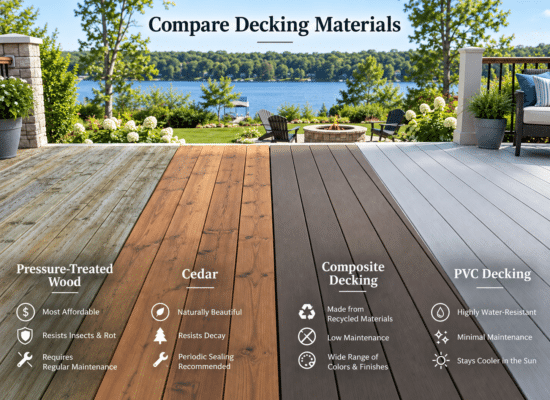
Pressure-treated pine is one of the most common decking materials available.
The default across most of the country, and there’s a reason: it’s the cheapest option and every lumberyard stocks it.
Southern yellow pine is treated with copper-based preservatives that resist rot and insects. It works with ordinary tools. A competent DIYer can build with it.
The trade-off is movement. Pine checks, cups, and twists as it dries, and a board that looked straight at delivery may not be by August. Plan on cleaning it annually and re-sealing every one to three years depending on exposure. Skip that and it turns grey and splintery faster than people expect.
Choosing the right decking materials can save you time and money on maintenance.
One non-negotiable: the copper in the treatment corrodes ordinary steel. Use hot-dipped galvanized or stainless fasteners and connectors, always.
Cedar and redwood
Western red cedar and redwood resist decay naturally through compounds in the heartwood, no chemical treatment required. They’re dimensionally stable, pleasant to work with, and genuinely attractive.
They’re also soft. Dropped furniture dents them, and dog claws leave marks. Left unfinished, both weather to a silver grey — plenty of people want this, but it should be a decision rather than a surprise.
Redwood availability skews heavily toward the West Coast, and pricing reflects that. East of the Rockies, cedar is usually the practical choice.
Tropical hardwoods (ipe, cumaru, garapa)
These tropical hardwoods are highly sought after as decking materials due to their durability.
Ipe is the benchmark: extraordinarily dense, well over 3,500 lbf on the Janka hardness scale — more than double white oak. It shrugs off scratches, resists insects without treatment, and some tropical hardwoods carry a Class A flame-spread rating, which matters in fire-prone regions.
It’s also demanding. Every fastener hole needs pre-drilling. Blades dull quickly. The weight alone slows a crew down, and labor costs reflect that. Most installations use hidden fasteners or plugged screws because face-screwing this material looks wrong.
Left alone it silvers; keeping the brown requires a UV-blocking oil roughly annually. Source FSC-certified stock — sustainability varies enormously by supplier.
Capped composite
Capped composite is gaining popularity among homeowners as one of the top decking materials.
Wood flour blended with polyethylene, wrapped in a co-extruded polymer shell. The cap is what separates modern composite from the uncapped products of the early 2000s that stained, faded, and grew mold. If someone tells you composite decking is a mistake based on a deck built in 2004, they’re describing a different product.
Capped composite doesn’t need sealing or staining. Wash it and move on. Warranties commonly run 25 years or more, though read them carefully — many are prorated, and fade-and-stain coverage is usually separate from structural coverage.
Two honest drawbacks. It gets hot in direct sun, and dark colors get considerably hotter than light ones. And while the cap resists scratching, it doesn’t prevent it — deep scratches can’t be sanded out the way they can on wood.
PVC
PVC is another excellent choice in the realm of decking materials.
Cellular PVC contains no wood at all. Nothing in it can rot, and nothing in it feeds mold. It’s the lightest of the synthetics and typically the most expensive.
Because it’s pure plastic, it expands and contracts with temperature more than composite does. Gapping and fastening details matter more here, which makes installer experience with the specific product worth asking about.
Modified wood
Modified wood offers characteristics that can enhance your choice of decking materials.
A smaller category worth knowing. Thermally modified wood is heat-treated — no chemicals — to reduce its ability to absorb moisture. Acetylated wood is chemically modified to a similar end. Both deliver real wood appearance with substantially better stability and decay resistance than untreated softwood.
Availability is thinner and pricing sits in the premium tier, but for someone who wants wood without the wood problems, it’s a legitimate option.
What Decking Materials Really Cost
The costs associated with different decking materials vary significantly.
Material price is the number everyone compares and the least useful one in isolation.
As a rough relative guide, using pressure-treated as the baseline for material only:
Understanding the cost of various decking materials is essential for budgeting.Each type of decking materials can have different maintenance requirements that affect overall cost.
| Material | Relative material cost | Realistic maintenance |
|---|---|---|
| Pressure-treated pine | 1× | Clean yearly, seal every 1–3 years |
| Cedar | ~1.5–2× | Clean yearly, finish every 2–3 years |
| Capped composite | ~2–4× | Wash periodically |
| Modified wood | ~3–4× | Minimal; optional UV finish |
| PVC | ~3–5× | Wash periodically |
| Ipe / tropical hardwood | ~3–5× | Oil yearly to keep color, or let it silver |
These ratios move with region, grade, and market conditions, so treat them as a shape rather than a quote.
The number that actually decides things is 20-year total cost: material, installation, plus two decades of stain, sealer, cleaner, and either your weekends or someone else’s labor. Run that and pressure-treated’s advantage narrows considerably. It doesn’t always disappear — if you’re selling in five years, low upfront cost may genuinely be the right answer.
Considering the long-term costs of decking materials is crucial before making your final decision.
When you collect bids, insist on line items separating substructure, decking, railing, stairs, and finishing. A quote expressed only as a price per square foot hides where the money goes and makes comparison impossible.
The Part Nobody Shops For
Be aware of the installation complexities related to different decking materials.
Here’s what gets lost in material comparisons: the boards are the part you see, and the least important part structurally.
Investigations into deck collapses point consistently at one thing — the ledger, the board fastening the deck to the house. Nailed instead of bolted, or installed without proper flashing so water tracks into the rim joist and quietly rots it. A ledger failure doesn’t announce itself. The deck looks fine until it isn’t.
Things worth confirming before framing starts:
- Ledger attachment and flashing. Through-bolts or structural screws, never nails, with flashing that directs water out rather than behind the board.
- Footings below the frost line. Depth requirement varies by region; your building department knows the number.
- Joist spacing matched to the product. Sixteen inches on center is typical, but many composite and PVC boards require 12 inches for diagonal patterns or stair treads. This is a manufacturer specification, not a preference.
- Joist tape. Butyl tape over joist tops seals around fastener penetrations and keeps water out of the framing. It’s one of the cheapest upgrades available and adds years to the substructure.
- Corrosion-rated hardware. Hot-dipped galvanized minimum in treated lumber; stainless within a few miles of salt water.
- Permits and inspection. Decks over a certain height almost always require them. It’s also your free second set of eyes on the ledger.
Spending premium money on boards over an under-built frame is backwards. The frame decides the lifespan.

Site Factors That Override Everything Else
Wildfire zones. In California’s designated hazard severity zones, decking must meet ignition-resistance requirements under the state’s WUI rules, and other western states have adopted similar provisions. This narrows the field before preference enters the picture. Check local requirements first.
Coastal exposure. Salt air attacks fasteners and hardware aggressively. Stainless is worth the premium here.
Full sun. Surface temperature is the most common regret with synthetic decking. Choose lighter colors, or plan shade into the design from the start — a pergola or roof structure changes the calculation entirely. Our covered patio roof ideas cover the options.
Choosing the right decking materials can significantly influence the longevity of your outdoor space.
Heavy shade and damp. Organic content feeds mold. Wood and even wood-composite decks in permanently shaded, poorly ventilated spots need more cleaning. PVC has the clear edge here.
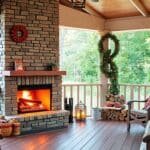
Fire features. If a fire pit or outdoor fireplace is in the plan, clearance and surface protection need designing in, not adding later. Our outdoor wood-burning fireplace guide covers the siting considerations.
Pulling It Together
Once the material is settled, the remaining decisions are about how the deck gets used. Stairs and access shape the layout more than people anticipate — if you’re working with grade changes, outdoor staircase options are worth reviewing early rather than late.
Color should be chosen against your siding and trim, not in isolation — a grey composite that looks sharp on a sample can fight a warm-toned house. If you’re coordinating the whole exterior, our modern farmhouse exterior ideas and guide to choosing exterior wall materials are useful references.
When selecting decking materials, consider how they will complement your overall design.
And budget for the finishing pieces. Outdoor lighting and weather-appropriate furniture are what turn a platform into a room people actually use. They’re the line items most likely to get cut, and the ones most likely to be missed.
Key Takeaways
-
- Choosing decking materials is choosing a maintenance schedule. Match it to your honest appetite for upkeep, not your aspirational one.
- Pressure-treated pine wins on upfront cost and loses on annual effort. Strong choice if you’re selling within a few years.
- Cedar and redwood offer natural decay resistance and good workability, but dent easily and grey without finishing.
- Capped composite and PVC eliminate sealing entirely. Composite runs hot in sun — go light-colored in full exposure. PVC costs more and moves more with temperature.
- Tropical hardwoods like ipe are exceptionally durable but expensive to install and require annual oiling to hold color.
Remember that different decking materials can enhance or detract from your home’s value.
- Compare 20-year total cost, not material price. Upfront savings on wood get spent on sealer and weekends.
- The ledger connection, flashing, footings, and fastener corrosion rating determine the deck’s lifespan more than the board choice does.
- Wildfire zone, coastal salt, and sun exposure can eliminate options before preference matters. Check local requirements first.
Ultimately, the choice of decking materials should align with your lifestyle and preferences.
FAQ — People Also Ask
What is the best decking material overall?
There isn’t one. Capped composite is the most common answer for low-maintenance longevity at a reasonable price, but pressure-treated pine is the better choice on a tight budget or short ownership horizon, and PVC wins in damp, shaded, or coastal conditions. The right answer depends on your climate, budget, and how much upkeep you’ll actually do.
It’s important to ask questions about the decking materials you are considering.
Is composite decking worth the extra cost?
Usually yes if you’re staying in the house ten or more years. You pay significantly more upfront and recover it in sealer, stain, and labor you never spend. Under about seven years of ownership, the math is far less convincing.
Does composite decking get too hot to walk on?
It can, particularly in dark colors under full sun. Color matters more than brand — a light board and a dark board from the same product line can differ substantially in surface temperature. If barefoot use matters, choose light colors or plan shade.
How long does each decking material last?
With reasonable maintenance: pressure-treated pine commonly reaches 15 years or more, cedar 15 to 20, capped composite and PVC 25 to 30-plus, and tropical hardwood 30 to 50. These assume a sound substructure — a failing frame ends the deck regardless of what’s on top.
Maintenance expectations for various decking materials should be clearly understood.
What decking material requires the least maintenance?
PVC. With no organic content, there’s nothing to rot or feed mold, so upkeep is essentially washing. Capped composite is close behind and usually costs less.
Can I install composite decking over an existing wood frame?
Sometimes, but inspect first. The frame must be structurally sound with no rot, and joist spacing has to meet the new product’s requirement — many composites need 12 inches on center for diagonal layouts or stairs where wood tolerated 16. Also check the ledger and flashing while the boards are off. It’s the best access you’ll ever have.
Do I need a permit to build a deck?
In most jurisdictions, yes, particularly above a certain height or when attaching to the house. Requirements vary, so confirm with your local building department before starting. The inspection is also useful protection against exactly the ledger mistakes that cause failures.
What fasteners should I use with pressure-treated lumber?
Hot-dipped galvanized or stainless steel. The copper-based preservatives in modern treated lumber corrode ordinary steel fasteners. Within a few miles of salt water, upgrade to stainless throughout, including joist hangers and connectors.
Choosing the right fasteners for your decking materials is crucial for longevity.