


Choosing the best attic insulation is not simply a matter of buying the material with the highest R-value. Your climate, existing insulation, attic ventilation, air leakage, roof design, moisture conditions, budget, and whether the attic is vented or conditioned all affect the right choice.
Table Of Content
- What Is the Best Attic Insulation for Most Homes?
- Quick comparison of attic insulation types
- Understand R-Value Before Comparing Materials
- How much attic insulation do you need?
- Air Seal Before Adding More Insulation
- 1. Blown-In Cellulose: Strong Choice for Existing Attics
- Cellulose works particularly well when
- 2. Blown-In Fiberglass: Practical and Widely Applicable
- 3. Fiberglass Batts: Good When the Attic Layout Is Simple
- 4. Mineral Wool: Durable but Often More Expensive
- 5. Spray Foam Insulation: Powerful but Not an Automatic Upgrade
- Open-cell spray foam
- Closed-cell spray foam
- Best Attic Insulation for Hot and Cold Climates
- Cold climates
- Hot climates
- Mixed climates
- Attic Ventilation and Insulation Must Work Together
- When Should Existing Attic Insulation Be Removed?
- How Do You Know Whether Your Attic Needs More Insulation?
- Best Attic Insulation Is Only Part of the Energy-Efficiency Equation
- DIY or Hire an Insulation Contractor?
- Common Attic Insulation Mistakes
- Which Attic Insulation Should You Choose?
- Key Takeaways
- FAQ Section – People Also Ask
- What is the best attic insulation for most homes?
- Is cellulose or fiberglass better for attic insulation?
- Is spray foam the best attic insulation?
- What R-value should attic insulation have?
- Can you put new attic insulation over old insulation?
- Should I remove old attic insulation first?
- Should I air seal my attic before insulating?
- How can I tell if I need more attic insulation?
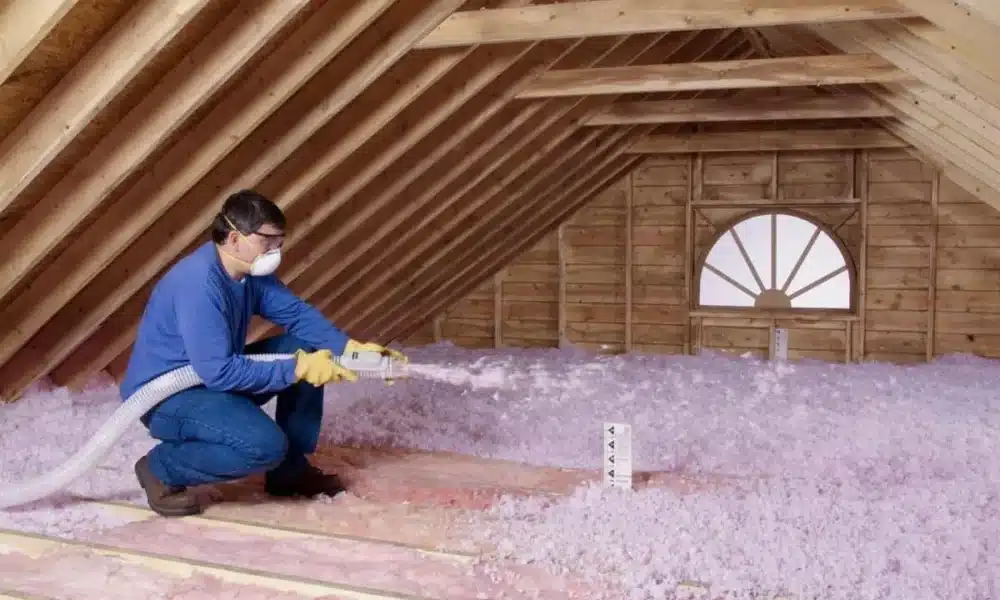
For many existing U.S. homes, blown-in cellulose or fiberglass provides a practical way to improve an unfinished attic floor. Spray foam can solve different problems, particularly where the roof deck becomes part of the home’s thermal envelope, but it costs more and requires careful design and professional installation.
This My NEXT HOUSE PROJECT guide compares the major attic insulation types, explains R-value in plain English, and shows what homeowners should inspect before spending money on insulation.
What Is the Best Attic Insulation for Most Homes?
There is no single material that wins in every house.
For a conventional vented attic where insulation sits on the attic floor, blown-in cellulose and blown fiberglass are often practical choices because they can cover large areas and work around framing and other obstructions. ENERGY STAR identifies loose-fill fiberglass, cellulose, and mineral wool as suitable for unfinished attic floors and hard-to-reach areas.
For accessible joist bays, fiberglass or mineral-wool batts can also work well when they are carefully cut and fitted without gaps or compression.
Spray polyurethane foam plays a different role. It may be used on an attic floor or roof deck, but ENERGY STAR classifies sprayed foam installation as an advanced project requiring a qualified installer.
So the best attic insulation depends as much on where and how it is installed as on what the insulation is made from.
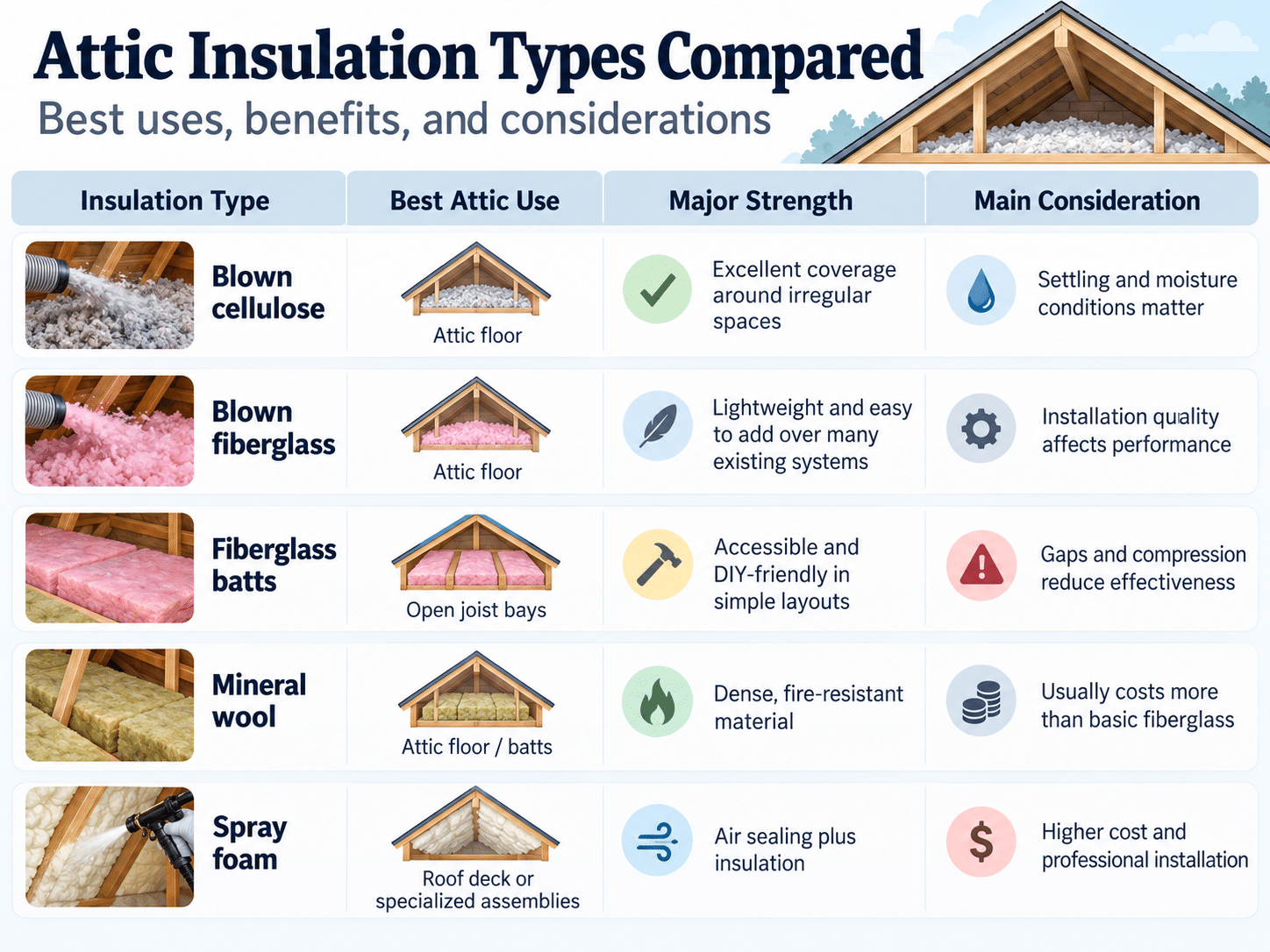
Quick comparison of attic insulation types
| Insulation Type | Typical Attic Use | Major Strength | Main Consideration |
|---|---|---|---|
| Blown cellulose | Attic floor | Excellent coverage around irregular spaces | Settling and moisture conditions matter |
| Blown fiberglass | Attic floor | Lightweight and easy to add over many existing systems | Installation quality affects performance |
| Fiberglass batts | Open joist bays | Accessible and DIY-friendly in simple layouts | Gaps and compression reduce effectiveness |
| Mineral wool | Attic floor/batts | Dense, fire-resistant material | Usually costs more than basic fiberglass |
| Spray foam | Roof deck or specialized assemblies | Air sealing plus insulation | Higher cost and professional installation |
Understand R-Value Before Comparing Materials
R-value measures resistance to heat flow. A higher R-value means greater resistance to heat transfer.
But R-value should not be confused with insulation quality alone.
A high-R-value product installed with gaps, compressed around wiring, missing near eaves, or exposed to uncontrolled air movement may perform worse than a modestly rated material installed correctly.
ENERGY STAR specifically notes that insulation performance depends heavily on installation quality.
That is why the best attic insulation project should begin with the entire attic assembly rather than a product label.
How much attic insulation do you need?
Recommended levels vary by U.S. climate zone and by how much insulation is already present.
The amount of insulation your attic needs depends heavily on location and existing insulation levels. Check ENERGY STAR’s recommended attic R-values by climate zone before deciding how much insulation to add.
For retrofitting an existing wood-framed home, ENERGY STAR currently recommends:
| Climate Zone | Uninsulated Attic | Attic With About 3–4 Inches Existing |
|---|---|---|
| Zone 1 | R-30 | R-25 |
| Zone 2 | R-49 | R-38 |
| Zone 3 | R-49 | R-38 |
| Zones 4A–4B | R-60 | R-49 |
| Zones 4C, 5 and 6 | R-60 | R-49 |
| Zones 7–8 | R-60 | R-49 |
These recommendations vary with construction and climate, so use your location and existing assembly rather than assuming every U.S. attic needs the same amount.
If you are unsure what is already in the attic, consider starting with an inspection. My NEXT HOUSE PROJECT’s guide to attic inspection cost and what an inspection should cover explains what homeowners can expect before an insulation upgrade.
Air Seal Before Adding More Insulation
This is one of the most important steps homeowners miss.
Insulation slows heat transfer. It does not automatically stop air from leaking through gaps around plumbing penetrations, wiring, top plates, attic hatches, duct chases, recessed fixtures, and other openings.
ENERGY STAR recommends air sealing the attic before adding insulation.
Imagine wearing a thick winter sweater in strong wind. The sweater provides insulation, but moving air still finds a way through. Adding another sweater does not solve the underlying problem as effectively as adding a wind-resistant outer layer.
A house behaves differently, of course, but the principle helps explain why insulation and air sealing should work together.
Before installing the best attic insulation you can afford, inspect for:
- penetrations between the living area and attic
- open chases around plumbing or ducts
- gaps around attic access panels
- improperly sealed wiring penetrations
- damaged or disconnected ductwork
- bathroom fans exhausting into the attic
- signs of roof leakage or moisture
Correcting those problems first makes the insulation upgrade more meaningful.
1. Blown-In Cellulose: Strong Choice for Existing Attics
Cellulose is a loose-fill insulation commonly made from processed fiber and installed with blowing equipment.
Its biggest advantage in an existing attic is coverage.
Loose material can settle around framing members, pipes, electrical boxes, and irregular areas where perfectly fitting batt insulation would take considerably more cutting.
That makes cellulose one of the strongest candidates for the best attic insulation in older homes with uneven attic layouts.
Cellulose works particularly well when:
- existing attic insulation is thin or inconsistent
- framing makes batt installation difficult
- you need to cover a broad attic floor
- the attic remains vented and unconditioned
- existing insulation can remain safely in place
ENERGY STAR notes that loose-fill insulation can be installed over existing fiberglass systems in appropriate applications, so complete removal is not automatically necessary.
Removal may still be warranted if the existing material is wet, contaminated by pests, mold-damaged, or affected by another problem that should be corrected first.
2. Blown-In Fiberglass: Practical and Widely Applicable
Blown fiberglass serves a similar purpose but uses loose glass fibers instead of cellulose.
It works well across open attic floors and can create relatively uniform coverage when installed properly.
For many homeowners comparing cellulose and fiberglass, neither choice should be judged solely on advertised R-value per inch. Consider installed depth, total R-value, air sealing, moisture control, contractor quality, and price.
Blown fiberglass may be the best attic insulation when you want lightweight loose-fill material and need to cover an existing attic without extensively disturbing the current insulation.
Installation depth should remain consistent across the attic. Thin areas near eaves and hard-to-reach corners can become thermal weak points even when the center of the attic looks well insulated.
ENERGY STAR advises homeowners to check not only insulation depth but also whether coverage is evenly distributed.
3. Fiberglass Batts: Good When the Attic Layout Is Simple
Fiberglass batts remain one of the most recognizable insulation products in American homes.
They’re pre-cut or rolled sections designed to fit between framing members.
Their main advantage is simplicity. In a clean attic with open, regularly spaced joists and few obstacles, batts can be straightforward to install.
The weakness is equally straightforward: they have to fit well.
Poorly cut batts can leave gaps around:
- pipes
- wires
- framing intersections
- electrical boxes
- attic access openings
- roof transitions
Compression is another common problem. Stuffing a thick batt into a shallow cavity does not automatically produce its labeled performance.
Batts may be the best attic insulation for a homeowner who has an uncomplicated attic layout and can install each section carefully, but blown material is often more forgiving in a complicated retrofit.
4. Mineral Wool: Durable but Often More Expensive
Mineral wool, sometimes called rock wool or stone wool depending on the product, is available in batt and loose-fill forms.
Homeowners often consider it because of its density and fire-resistant properties.
It can be especially useful where a more rigid batt is helpful for precise fitting.
However, attic insulation is usually installed across a large area. Material cost therefore matters, and mineral wool may be difficult to justify solely on thermal performance when less expensive materials meet the project’s requirements.
That doesn’t make it a poor product. It simply means the best attic insulation should be selected according to the assembly and budget rather than assuming the premium option is automatically better.
5. Spray Foam Insulation: Powerful but Not an Automatic Upgrade
Spray foam gets considerable attention because it can provide insulation and air-sealing characteristics in one system.
There are two broad categories:
Open-cell spray foam
Open-cell foam is lighter and generally allows more vapor movement through the material.
Closed-cell spray foam
Closed-cell foam is denser and generally delivers more R-value within limited thickness.
The appeal is obvious. Spray foam can reach unusual surfaces and create a continuous layer when designed and installed properly.
But that does not mean every attic should be sprayed.
Applying foam to the underside of roof decking can change the attic from a traditionally vented space toward an unvented or conditioned roof assembly. That affects moisture behavior, ventilation strategy, HVAC conditions, roof inspection, and sometimes future roof work.
This is why spray foam may be the best attic insulation for a specific roof assembly while being unnecessary for a straightforward vented attic where air sealing and loose-fill insulation could accomplish the objective more economically. ENERGY STAR categorizes spray foam installation as advanced work requiring a certified installer.
If the roof itself is approaching replacement, coordinate insulation decisions with the roofing scope. My NEXT HOUSE PROJECT’s roof replacement planning guide explains why insulation, moisture control, and ventilation should be considered alongside the roof system rather than as unrelated projects.
Best Attic Insulation for Hot and Cold Climates
Climate changes the target R-value, moisture strategy, HVAC loads, and details of the roof assembly.
Cold climates
Cold-climate homes generally benefit from higher attic R-values and careful air sealing because warm indoor air can move toward colder attic surfaces during winter.
The goal is not simply keeping heat inside. Moisture transport also matters.
Bathroom exhaust fans, plumbing penetrations, attic access doors, and ceiling gaps should be addressed before burying them beneath additional insulation.
Hot climates
In cooling-dominated regions, attic insulation helps reduce heat flow from the roof and attic toward conditioned rooms below.
Air sealing still matters. A leaky ceiling plane allows conditioned air to escape into the attic and increases HVAC demand.
Mixed climates
Homes experiencing hot summers and cold winters need insulation that performs effectively in both directions.
For these houses, the best attic insulation is often less about choosing an exotic material and more about creating a complete system: air sealing, appropriate R-value, uniform coverage, proper ventilation where required, and moisture control.
Homeowners replacing heating and cooling equipment should deal with envelope problems first when practical. My NEXT HOUSE PROJECT’s heat pump versus furnace guide notes that new HVAC equipment does not correct poor insulation or attic air leakage.
Attic Ventilation and Insulation Must Work Together
One of the easiest insulation mistakes is blocking soffit vents.
In a conventional vented attic, outside air typically enters through lower intake vents and exits higher in the roof system. Insulation should not obstruct the intended ventilation path.
Baffles or ventilation chutes are often used at eaves to preserve airflow while allowing insulation to extend toward the exterior wall.
My NEXT HOUSE PROJECT’s guide to roof ridge venting provides more detail on how ridge ventilation interacts with the rest of the attic.
Do not assume adding extra roof vents is automatically better. Ventilation needs to be designed as a system, with appropriate intake and exhaust.
When Should Existing Attic Insulation Be Removed?
Adding insulation over existing material is often acceptable when the original insulation is dry, uncontaminated, and compatible with the new installation. ENERGY STAR specifically notes that homeowners do not necessarily need to use the same insulation type when adding additional material.
Removal becomes more reasonable when you find:
- significant roof-leak damage
- rodent contamination
- widespread mold or moisture damage
- insulation covering unsafe electrical conditions
- extensive remodeling that requires access
- heavily disturbed or degraded material
- contamination that needs professional remediation
A roof leak should be corrected before new insulation is installed. Otherwise, new material can conceal the problem and become damaged itself.
How Do You Know Whether Your Attic Needs More Insulation?
One quick visual check is to look across the attic floor.
ENERGY STAR says that if insulation is at or below the tops of the floor joists, additional insulation is probably needed. If the joists are completely buried and coverage is even, adding more may provide less benefit, though actual R-value should still be evaluated.
Measure insulation depth at several locations rather than just beside the attic hatch.
Also look for:
- bare spots
- compressed insulation
- uneven depth
- insulation displaced by previous contractors
- staining from water
- evidence of animals
- blocked soffit vents
A thermal-imaging inspection or home energy assessment can provide more context when comfort problems persist despite seemingly adequate insulation.
Best Attic Insulation Is Only Part of the Energy-Efficiency Equation
Attic work frequently produces better results when it is part of a whole-house strategy.
Insulation cannot correct:
- leaking ductwork
- an oversized or failing HVAC system
- major air leaks
- damaged roofing
- moisture intrusion
- poorly sealed windows or doors
My NEXT HOUSE PROJECT’s guide to home heating systems and energy-saving improvements discusses insulation and air sealing as part of reducing heating demand.
For broader efficiency planning, the site’s smart home trends guide also makes an important distinction: smart thermostats and controls can manage energy use, but they cannot compensate for major insulation and air-leakage problems.
Homeowners addressing several areas of the building envelope may also find the crawl space moisture guide useful, because moisture and insulation problems are not always confined to the attic.
DIY or Hire an Insulation Contractor?
Some insulation work is reasonable for experienced homeowners. Other work deserves professional involvement.
Simple fiberglass batt installation in a clean, open attic may be manageable if electrical, ventilation, moisture, and access conditions are understood.
Blown-in insulation requires equipment and careful depth control.
Spray foam should generally be treated as professional work.
Consider hiring a qualified insulation or building-performance contractor when:
- the attic is difficult or unsafe to access
- knob-and-tube or questionable wiring is present
- recessed fixtures require evaluation
- mold or significant moisture is visible
- pests have contaminated existing material
- roof decking shows staining
- HVAC equipment or extensive ductwork occupies the attic
- you are changing from a vented to unvented attic design
- spray foam is being considered
The cheapest quote is not necessarily the best one.
Ask what R-value will be installed, how depth will be verified, whether air sealing is included, how ventilation will be protected, and what happens if moisture or electrical problems are discovered.
Common Attic Insulation Mistakes
Even the best attic insulation material performs poorly when the surrounding work is wrong.
Common mistakes include installing new insulation before fixing a roof leak, skipping air sealing, blocking soffit vents, compressing fiberglass batts, leaving bare areas near eaves, insulating over unsafe heat-producing equipment, and assuming more insulation automatically solves every comfort problem.
A better sequence is:
Inspect → repair moisture problems → air seal → protect ventilation → insulate to the appropriate R-value → verify coverage.
That sequence is less glamorous than simply choosing a product, but it is much more useful.
Which Attic Insulation Should You Choose?
For a typical unfinished, vented attic, start by comparing blown cellulose and blown fiberglass.
For a simple attic with open joists and few obstructions, fiberglass or mineral-wool batts may also make sense.
For a roof assembly that requires the thermal boundary at the roof deck, spray foam may deserve consideration, but only after moisture, ventilation, roof, and HVAC implications are evaluated.
Ultimately, the best attic insulation is the material that achieves the required thermal performance as part of a correctly designed attic system.
Do not buy insulation by R-value alone.
Buy the solution that fits the house.
Key Takeaways
- The best attic insulation varies by attic design, climate, existing insulation, budget, and moisture conditions.
- Blown cellulose and blown fiberglass are strong choices for many unfinished attic floors.
- Fiberglass batts work best where framing is regular and the material can be fitted without gaps or compression.
- Spray foam can be valuable for specialized assemblies but should not automatically replace conventional attic insulation.
- Determine the target R-value from your climate zone rather than using a single national number.
- Air seal the ceiling plane before adding insulation whenever practical. ENERGY STAR specifically recommends this sequence.
- Never bury roof leaks, moisture problems, contaminated insulation, or unsafe electrical conditions beneath new material.
- In a vented attic, preserve airflow at soffits and other intended ventilation paths.
- Installation quality can be just as important as insulation type.
- Evaluate the whole attic system, not just the insulation product.
FAQ Section – People Also Ask
What is the best attic insulation for most homes?
For many existing homes with conventional vented attics, blown-in cellulose or fiberglass is a practical choice because loose-fill material covers broad attic floors and irregular spaces effectively. The ideal choice still depends on climate, existing insulation, ventilation, and moisture conditions.
Is cellulose or fiberglass better for attic insulation?
Both can perform well when installed correctly. Cellulose provides dense coverage around irregular spaces, while blown fiberglass is lightweight and widely available. Compare the required installed R-value, contractor quality, material cost, attic conditions, and installation depth instead of choosing based on material name alone.
Is spray foam the best attic insulation?
Sometimes, but not universally. Spray foam can provide insulation and air sealing and can be useful in roof-deck applications. However, it is more complex and can change how the roof and attic manage heat and moisture. ENERGY STAR classifies spray foam installation as advanced work requiring a qualified installer.
What R-value should attic insulation have?
It depends on climate zone and existing insulation. ENERGY STAR’s retrofit recommendations range from R-30 in some warm-climate uninsulated attics to R-60 in colder climate zones. Always verify local code and project requirements.
Can you put new attic insulation over old insulation?
Often, yes. ENERGY STAR notes that additional insulation does not necessarily have to match the existing material. Loose fill can be added over batts in appropriate situations, for example. Existing insulation should first be checked for water damage, contamination, pests, and other problems.
Should I remove old attic insulation first?
Not routinely. Removal is more appropriate when existing insulation is wet, mold-damaged, contaminated by pests, or interfering with repairs. Clean, dry existing insulation can often remain beneath additional insulation.
Should I air seal my attic before insulating?
Yes, in most retrofit situations. ENERGY STAR recommends sealing attic air leaks before adding insulation because uncontrolled air movement can reduce comfort and energy performance.
How can I tell if I need more attic insulation?
Look across the attic floor. If the tops of the joists are visible or the insulation is approximately level with them, ENERGY STAR says you probably need additional insulation. Measure several areas because insulation depth can vary considerably across the attic.