



A deck board can look nearly identical under fluorescent store lighting and perform completely differently through a humid summer, a snowy winter, and three years of dragged patio chairs. That is why composite decking reviews are useful only when you know what to look for. The best composite decking reviews do more than say a deck is “beautiful” or “terrible.” They reveal how a product handles heat, scratches, staining, fading, installation, and the realities of the homeowner’s climate.
Table Of Content
- What Composite Decking Reviews Actually Tell You
- The Big Trade-Off: Lower Maintenance, Higher Upfront Cost
- Capped Composite, Uncapped Composite, and PVC Are Not the Same
- Heat Is the Review Detail Homeowners Should Not Skip
- How to Read Complaints About Scratches, Stains, and Fading
- Installation Reviews Matter as Much as Board Reviews
- A Better Way to Compare Composite Decking Reviews
Composite decking can be a smart long-term upgrade for homeowners who are tired of sanding, staining, and replacing splintered wood. When looking at composite decking reviews, it’s clear it is not a one-size-fits-all material, and the highest-priced board is not automatically the best choice for every backyard. Your deck’s sun exposure, foot traffic, budget, color choice, and installation plan matter just as much as the brand name on the sample.
What Composite Decking Reviews Actually Tell You
A useful review identifies the deck line, board color, age of the installation, and local conditions. A dark board in Phoenix faces a different test than a light gray board in Minneapolis. Likewise, a covered front porch with occasional use will not expose material to the same wear as a pool deck used by kids, dogs, and wet feet all summer.
When reading composite decking reviews, pay close attention to repeated comments rather than one dramatic complaint. If multiple owners mention that a certain dark color gets uncomfortably hot, assume that is a real trade-off.
Pay close attention to repeated comments rather than one dramatic complaint. If multiple owners mention that a certain dark color gets uncomfortably hot, assume that is a real trade-off. If several DIY installers say the boards are easy to cut but the hidden fasteners are fussy, that is valuable planning information, not necessarily a reason to reject the product.
Also separate product problems from installation problems. Loose boards, uneven gaps, squeaks, and poor drainage may result from improper joist spacing, inadequate framing, or skipped expansion allowances. Composite boards expand and contract with temperature changes more than wood, so details such as end gaps and fastener placement matter.
The Big Trade-Off: Lower Maintenance, Higher Upfront Cost
Most homeowners consider composite because they want less annual work. Unlike conventional wood decking, composite generally does not need routine staining or sealing. A seasonal wash with mild soap, water, and a soft brush is usually enough for ordinary dirt and pollen.
That convenience comes with a higher purchase price. Material costs vary widely by board profile, protective cap, texture, and color, but composite commonly costs more upfront than pressure-treated lumber. Installation can also cost more because hidden fasteners, specialty trim, picture-frame borders, and manufacturer-specific requirements add labor.
The value calculation changes when you plan to stay in the home for many years. Wood may be the lower-cost choice on day one, especially for a basic platform deck. Composite can make more financial sense when you factor in repeated staining supplies, maintenance time, and the likelihood of replacing weathered boards. If you expect to sell soon, choose the option that improves the outdoor space without overbuilding for your neighborhood.
As you review your options, consider how composite decking reviews reflect the long-term savings on maintenance and replacement, which can add up significantly over time.
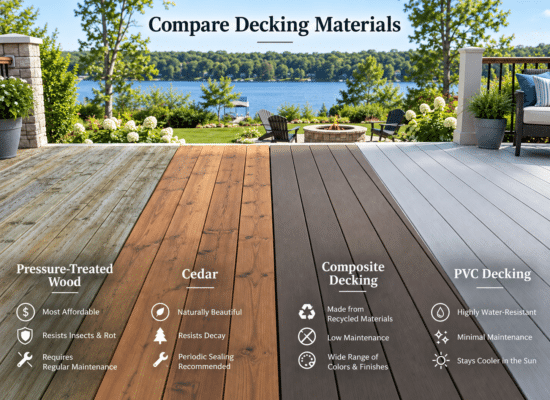
Capped Composite, Uncapped Composite, and PVC Are Not the Same
Many composite decking reviews blur together products that have very different construction. Before comparing comments, confirm what material is actually being reviewed.
Understanding the differences highlighted in composite decking reviews can help clarify which product best suits your needs and budget.
Capped composite boards have a composite core covered by a protective polymer shell on three or four sides. This cap is designed to improve resistance to staining, fading, moisture, and mold. For many homeowners, capped composite offers the most balanced mix of appearance, durability, and price.
Uncapped composite is usually less expensive, but it can be more vulnerable to surface staining and moisture-related issues. It may still work for a lower-budget project, particularly a covered or lightly used deck, but it is worth reading the maintenance requirements closely.
Reading composite decking reviews about uncapped options can help determine whether this lower-cost alternative will meet your project’s requirements.
PVC decking is made primarily from plastic rather than a wood-plastic composite. It is often very moisture resistant and can be lighter than composite, but it tends to cost more and may have a different feel underfoot. Some owners prefer its performance near water, while others like the more wood-like texture available in many composite lines.
Heat Is the Review Detail Homeowners Should Not Skip
Nearly every deck surface gets warm in direct sun, including wood. Still, composite and PVC can retain enough heat to make bare feet uncomfortable, especially in dark colors and on south- or west-facing decks.
When reading reviews, look for the color of the board, the location, and whether the deck has shade. A complaint that a charcoal board becomes hot in full Texas sun is not surprising, but it is highly relevant if your yard has the same exposure. A pale or medium-tone board can be a more practical choice for a sunny deck, even if you prefer the drama of a darker color.
Texture matters, too. Embossed grain and brushed finishes can improve traction, particularly around pools or rainy entryways. Yet deep texture can hold more dirt and require a little more brushing during cleanup. Ask for a full-size sample, place it outside for a few hours, and stand on it with bare feet. That simple test can prevent a costly color mistake.
The texture highlighted in composite decking reviews can impact not only the aesthetic appeal of your deck but also its practicality and safety.
How to Read Complaints About Scratches, Stains, and Fading
Composite is low maintenance, not no maintenance. Reviews that mention scratches should be taken seriously if your household moves furniture often, has large dogs, or uses the deck as an active entertaining space. Dragging metal chair legs, grill equipment, or planters across any deck surface is hard on it.
Capped boards generally resist everyday stains well, but sunscreen, grease, leaves, pollen, and spilled food should still be cleaned promptly. Grease from a grill deserves particular attention. Place grills on a fire-safe mat where permitted, keep them away from railings, and clean splatters before they bake into the surface.
Color changes also need context. Most modern boards are designed to resist fading, but no exterior material stays completely unchanged after years of ultraviolet exposure. Some product lines intentionally weather slightly during an initial period. Review photos taken immediately after installation and photos taken two or three years later are more useful than a single showroom sample.
Installation Reviews Matter as Much as Board Reviews
Installation insights from composite decking reviews may save you from costly mistakes, ensuring your new deck is built to last.
A quality board installed on weak framing will not perform like a quality deck. Before choosing a product, verify its required joist spacing, approved fasteners, ventilation needs, and overhang limits. Diagonal board layouts may require closer joist spacing than straight runs.
For a DIY installation, choose a system with clear instructions and readily available matching fasteners, fascia, plugs, and railing components. A cheap board can become expensive if its accessories are difficult to source or if mistakes leave you with visible holes and uneven edges.
Professional installation is often worth considering for elevated decks, stairs, complex railings, structural repairs, or projects requiring permits. A contractor should inspect the existing ledger connection, posts, beams, footings, and framing before simply resurfacing an old deck. If the structure beneath is not sound, new composite boards will not fix the underlying problem.
A Better Way to Compare Composite Decking Reviews
Consider the insights from composite decking reviews as a vital part of the evaluation process for your decking material.
Use reviews to narrow the field, then make the final decision with samples, specifications, and a realistic project budget. Compare products on the same criteria rather than relying on star ratings alone:
-
- Surface temperature in conditions similar to your yard
Understanding how various composite decking reviews assess different performance metrics can streamline your decision-making.
-
- Stain, scratch, and traction performance for your household
- Board warranty terms and the labor coverage, if any
- Required framing, fasteners, trim, and installation complexity
- Total installed cost, including stairs, railings, demolition, and permits
Utilizing information from composite decking reviews allows you to compare products more accurately based on conditions specific to your property.
Warranty length can be reassuring, but read what it covers. A long limited warranty may address manufacturing defects while excluding labor, improper installation, standing water, or damage from misuse. It should support your decision, not replace a careful inspection of the product and installation plan.
The right deck is the one you will enjoy using without resenting its upkeep or its price tag. Bring home samples, check them in your actual sunlight, price the complete project instead of the boards alone, and let real homeowner feedback help you ask better questions before work begins.
Ultimately, composite decking reviews serve as a valuable resource for making informed choices that enhance your outdoor living experience.