

You turn the handle to hot and get a thin, disappointing stream. Flip to cold and it comes roaring out like nothing’s wrong. When a hot-water faucet has weak pressure while the cold side behaves normally, that lopsided behavior is actually good news: it narrows the problem down considerably. Both sides of your faucet are fed by the same water main at the same pressure, so the difference has to be something the hot water passes through and the cold water doesn’t. This guide walks you through how to tell whether the restriction is at the faucet itself or back at the water heater, which checks to run first, what you can reasonably fix in an afternoon, and when the symptom is pointing at a bigger problem worth calling a plumber for.
Table Of Content
- Weak Hot Water Is Usually a Flow Problem, Not a Pressure Problem
- The First Test: One Fixture, or Every Hot Tap?
- When a Single Hot-Water Faucet Has Weak Pressure
- Start with the aerator
- Check the faucet cartridge
- Look at the angle stop under the sink
- Inspect the supply line
- When Hot Water Is Weak Throughout the House
- A partially closed valve at the water heater
- Sediment and scale in the tank
- Failed heat-trap nipples or a degraded dip tube
- Old galvanized hot-water piping
- Tankless-specific restrictions
- A failed recirculation crossover valve
- A 20-Minute Diagnostic Walkthrough
- What to Handle Yourself and What to Hand Off
- When Weak Hot Water Is Telling You Something Bigger
- Key Takeaways
- FAQ Section — People Also Ask
If you’re experiencing issues, a hot-water faucet has weak pressure, it can be frustrating. Understanding the problem can help you troubleshoot effectively.
Weak Hot Water Is Usually a Flow Problem, Not a Pressure Problem
The distinction matters more than it sounds like it does, because it changes where you look.
Pressure is the force pushing water through your pipes, measured in psi. Flow is how much water actually arrives, measured in gallons per minute. Your house has one incoming pressure, set by the municipal main or your well pump and often regulated down by a pressure-reducing valve near where the line enters the house. That single pressure feeds the cold lines and the water heater alike.
Remember, if your hot-water faucet has weak pressure, it could be due to various factors like buildup in the lines or a malfunctioning component.
So if cold runs strong and hot runs weak, whole-house pressure isn’t your problem. Something is choking the flow somewhere along the hot side. And the hot side has a lot more places to get choked: it passes through the water heater, an extra set of shut-off valves, additional fittings, usually a longer run of pipe, and it does all of that at 120 degrees or more, which accelerates mineral scaling inside the pipe.
That’s the framework. Now you just have to figure out where the pinch point is.
The First Test: One Fixture, or Every Hot Tap?
Assessing whether your hot-water faucet has weak pressure at just one fixture or multiple can guide your repair process.
Before you touch a tool, go around the house and run hot water at every fixture you have. Kitchen sink, each bathroom sink, tub, shower, laundry tub. Give each one fifteen seconds.
You’re sorting the problem into one of two buckets:
Only one faucet is weak. The restriction is local — somewhere between the branch line and the spout. Skip to the single-fixture section below. This is the more common scenario and the more DIY-friendly one.
If only one hot-water faucet has weak pressure, focus your efforts locally to resolve the issue.
Every hot fixture is weak. The restriction is upstream, at or near the water heater, or in the main hot-water distribution piping. That’s the second section.
Some are weak, some aren’t. Look at what the weak ones have in common. Often they’re the farthest from the heater, or they’re all fed off one branch, or they’re all newer low-flow fixtures and you’re comparing them to an older faucet. Worth ruling out before you assume a defect.
One more sorting question: did this happen gradually or overnight? Gradual decline over months or years points to mineral buildup. A sudden change, especially right after plumbing work, a water main break in the neighborhood, or a water heater service call, points to a valve that got left partly closed or debris that got stirred loose and traveled downstream.
When a Single Hot-Water Faucet Has Weak Pressure
Work through these in order. The first one solves this more often than anything else on the list.
Start with the aerator
The aerator is the small screened fitting threaded into the tip of the spout. It has a fine mesh screen designed to catch debris, and it does its job well enough that it eventually clogs.
Unthread it (counterclockwise from your view facing the spout — a rubber jar-opener pad gives you grip without scratching the finish). Then run the hot water with the aerator off. If the flow jumps to normal, you’ve found it.
What you’ll usually see in the screen is one of two things: white or tan crumbly grit, which is mineral scale, or small white plastic flakes, which is a different problem entirely and points back at the water heater’s dip tube. Note which one you’re looking at.
Soak the aerator in white vinegar for an hour or so, brush the screen with an old toothbrush, and reinstall. If it’s corroded or the screen is torn, replace it. Aerators are inexpensive and standardized by thread size, though kitchen and bathroom faucets frequently use different sizes, so bring the old one to the store.
Note that aerators are flow-rated. Federal standards cap faucet aerators at a set gallons-per-minute maximum, and several states set stricter limits, so a 1.2 gpm replacement will genuinely feel weaker than the 2.2 gpm unit it replaced. If your “weak pressure” started the day you installed a new faucet, this may be the entire explanation.
Check the faucet cartridge
Checking the cartridge is crucial when you notice your hot-water faucet has weak pressure — this is often where the problem lies.
If clearing the aerator didn’t do it, the cartridge is next. This is the valve body inside the faucet that mixes hot and cold and controls flow.
Cartridges clog on the hot side specifically. Scale flaking off the inside of the water heater and hot pipes lands in the cartridge’s hot inlet port and builds a crust that narrows the opening. Single-handle faucets are especially prone to this because the hot and cold passages are small and adjacent.
Some cartridges clean up with vinegar. Many are cheap enough that replacement is the better use of your time, and common models are widely stocked — Moen’s 1225 and 1255 series and Delta’s RP-series cartridges are on the shelf at most hardware stores. Match the brand and model. If you don’t know the model, photograph the faucet’s underside and the cartridge itself before you go shopping.
Before you pull a cartridge, shut off both angle stops under the sink and open the faucet to relieve pressure.
Look at the angle stop under the sink
The angle stop is the small shut-off valve on the wall or floor under your sink — one for hot, one for cold. Two things go wrong here.
It’s partly closed. Someone shut it for a repair and only reopened it most of the way. Turn it fully counterclockwise and see if flow improves. Don’t force a stiff one; old multi-turn stops seize and the stem can snap.
Or the valve has failed internally. Older multi-turn stops have a rubber washer that can swell, deteriorate, or partially detach and act like a flap over the opening. Quarter-turn ball stops are more reliable and are the standard replacement. Swapping an angle stop is a straightforward job if the supply is compression-fitted, less so if it’s soldered.
Inspect the supply line
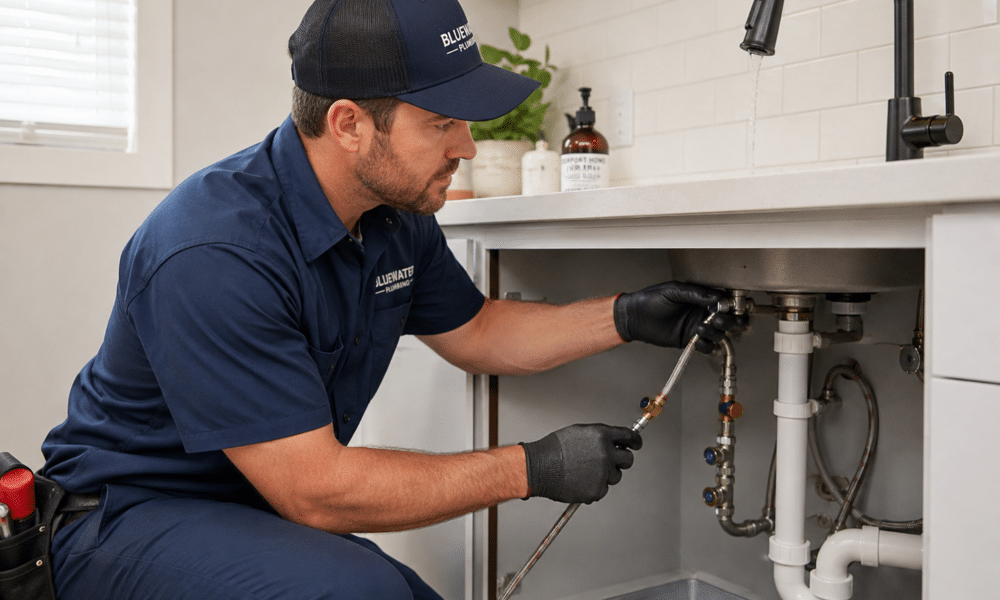
The braided flex line running from the angle stop to the faucet can kink behind the drain trap, especially if the cabinet is packed with cleaning supplies. It’s also possible for the internal washer at either end to deform and partially block the passage. Disconnect the hot line at the faucet end, aim it into a bucket, and crack the valve briefly. Strong flow there means the restriction is above that point.
When Hot Water Is Weak Throughout the House
Now you’re looking at the heater and the main hot distribution line.
A partially closed valve at the water heater
Check this first, every time, because it costs nothing and it’s a genuinely common cause.
Any failure at the water heater can mean your hot-water faucet has weak pressure throughout the house.
Your water heater has a shut-off valve on the cold inlet at the top. Because everything the heater delivers has to come in through that valve, restricting the inlet restricts hot output at every fixture in the house. Some installations have a valve on the hot outlet as well.
Confirm the handle is fully open. On a ball valve, the lever should sit parallel to the pipe. On an older gate valve with a round handwheel, open it fully, then back it off a quarter turn.
Be aware that gate valves fail in a way that hides itself: the brass gate can corrode and separate from the stem, so the handle turns normally while the gate sits partway down in the flow path. The handle tells you nothing in that case. If your heater has an old gate valve and everything else checks out, this is a real suspect, and replacing it with a quarter-turn ball valve is standard practice during a water heater replacement anyway.
Sediment and scale in the tank
Hard water deposits minerals on every hot surface it touches. In a tank heater, that settles to the bottom as a layer of sediment and also coats the interior.
Clogs caused by sediment can directly lead to a hot-water faucet has weak pressure, so regular maintenance is key.
Sediment alone doesn’t usually strangle flow, since the tank is a large open vessel. What it does is supply a steady stream of loose particles that travel downstream and clog aerators, cartridges, and screens. If you found grit in your aerator, this is where it came from.
Flushing the tank annually is the standard preventive step. On a heater that has never been flushed and has years of hardened buildup, be realistic: flushing may barely dent it, and in some cases stirring up a heavily scaled tank makes short-term debris problems worse before they get better.
Failed heat-trap nipples or a degraded dip tube
Two internal parts sit right in the flow path and are frequently overlooked.
Heat-trap nipples are the fittings where the cold inlet and hot outlet connect to the tank. Many contain a small plastic ball or flapper meant to stop heat from convecting up into the pipes. These can break apart, seat improperly, or catch sediment, and because 100% of your hot water passes through the outlet nipple, a restriction there shows up at every fixture. Replacing them requires draining the tank and breaking the connections loose, which is meaningful work but far cheaper than a new heater.
Replacing heat-trap nipples can often resolve cases where a hot-water faucet has weak pressure.
The dip tube carries incoming cold water to the bottom of the tank. A widely reported manufacturing problem affected dip tubes produced during a stretch of the mid-1990s, causing them to degrade and shed small white plastic particles into the water. Those particles are what jam aerators and cartridges. If you pulled white plastic flakes out of your aerator, this is your culprit, and note that a heater that old is likely past its expected service life regardless.
Old galvanized hot-water piping
If your house still has galvanized steel supply lines, corrosion and scale narrow the interior diameter over time until the effective opening is a fraction of the original. The hot lines almost always go first, since heat speeds the reaction.
Old piping can also be a culprit, as corrosion can lead to a hot-water faucet has weak pressure over time.
You can sometimes confirm this by cutting into a section during other work and looking at the cross-section — the buildup is unmistakable. The fix is repiping in copper or PEX, which is a real project with real cost, and there’s no partial workaround that lasts. Prices vary enormously depending on house size, layout, wall access, and local labor rates, so treat any number you read online as a starting point rather than an estimate.
Tankless-specific restrictions
Tankless units add a few possibilities.
There’s an inlet water filter screen, usually near the cold inlet connection, that catches sediment and needs periodic cleaning. It’s a common maintenance miss.
Tankless heaters also require a minimum flow rate to fire — typically well under a gallon per minute, but not zero. At a trickle, the burner won’t engage at all, which reads as “no hot water” rather than weak flow but gets described the same way. And because the unit heats water as it passes through a narrow heat exchanger, scale buildup inside that exchanger reduces flow directly. Descaling on the manufacturer’s recommended schedule matters more on tankless than on tank systems, particularly with hard water.
A failed recirculation crossover valve
Homes with a hot-water recirculation system may have a thermal bypass valve under the fixture farthest from the heater. When these fail, hot and cold can partially mix, producing lukewarm water and unusual flow behavior that’s easy to misread as a pressure problem. If you have a recirculation pump and the symptoms are strange rather than simply weak, mention it to whoever you call.
A recirculation system failure can confuse the issue when your hot-water faucet has weak pressure.
A 20-Minute Diagnostic Walkthrough
Run this in order and you’ll have your answer or a much shorter list of suspects.
- Run hot at every fixture. Note which are weak. This is your single most informative step.
- Check the water heater’s cold inlet valve. Confirm it’s fully open. Note whether it’s a gate or ball valve.
- Remove and inspect the aerator on an affected faucet. Look for grit versus white plastic flakes.
- Run flow with the aerator off. Restored flow means the aerator was it.
- Measure the flow rate. Use a fixture without an aerator, like a tub spout. Fill a gallon container and time it. Sixty seconds to fill a gallon is one gpm. Do this on hot and again on cold, and compare. The gap between the two numbers is your actual problem, and it’s a useful figure to give a plumber.
- Verify the angle stops under the affected sink are fully open.
- Disconnect the hot supply line at the faucet and test flow into a bucket. Strong here, weak at the spout, means the faucet is at fault.
What to Handle Yourself and What to Hand Off
Knowing when to step back and call in professionals can help if your hot-water faucet has weak pressure persists despite your efforts.
Reasonable DIY for most homeowners: cleaning or replacing aerators, replacing faucet cartridges, opening valves that were left partly closed, cleaning a tankless inlet screen, and flushing a tank heater if you’re comfortable with the drain procedure.
Worth calling a licensed plumber for: replacing angle stops on soldered supplies, replacing heat-trap nipples or a dip tube, replacing failed valves at the heater, descaling a tankless unit if you haven’t done it before, and anything involving galvanized repiping.
Two safety points. Water heaters operate at scalding temperatures, and draining one takes time to cool — rushing it causes burns. And any work on a gas heater that involves the gas connection or the flue belongs with a licensed pro, full stop.
Costs and timelines vary widely by region, by how accessible your plumbing is, and by what the plumber finds once the work starts. A cartridge swap is a small parts purchase and an hour. A repipe is a multi-day project. Get more than one quote on anything in between.
When Weak Hot Water Is Telling You Something Bigger
Pay attention if weak flow arrives alongside other symptoms. Rusty or discolored hot water, a heater more than about 10 to 12 years old, popping or rumbling from the tank, water pooling near the base, or a recurring pattern where you clear the aerator and it clogs again within weeks — that combination usually means the tank’s interior is deteriorating, and repairs stop being the economical choice.
Be alert for other symptoms that can indicate why your hot-water faucet has weak pressure, as this may hint at larger issues.
A single clogged aerator is a maintenance item. The same aerator clogging four times a year is a message.
Key Takeaways
-
- Weak hot water with normal cold water is a flow restriction on the hot side, not a house pressure problem. Both sides start at the same pressure.
- Your first diagnostic step is free: run hot water at every fixture. One weak faucet means a local restriction. All of them means the water heater or main hot line.
- The aerator is the single most common culprit at an individual faucet, and clearing it takes about ten minutes.
- What you find in the aerator screen matters. Mineral grit points to scale in the system; white plastic flakes point to a failing dip tube.
- A partially closed valve at the water heater’s cold inlet restricts hot water everywhere in the house, and a corroded gate valve can be partly closed while the handle still turns normally.
- Timing the fill of a one-gallon container gives you a real flow-rate number for both hot and cold. That comparison is more useful than any subjective description.
Understanding the mechanics of flow rates helps clarify why your hot-water faucet has weak pressure compared to cold.
- Repeated clogs, discolored hot water, and a heater past the 10-to-12-year mark together suggest replacement rather than continued repair.
FAQ Section — People Also Ask
Why is my hot water pressure low but cold is fine? Because the hot water passes through equipment and piping the cold water never touches. Both lines are fed at the same pressure from the same source, so the difference comes from the water heater, its shut-off valves, the extra fittings on the hot side, and the mineral scale that builds up faster in hot lines. The restriction is somewhere in that added path.
Can a water heater cause low hot water pressure throughout the house? Yes, in a few specific ways. A partly closed or internally failed valve at the cold inlet limits everything the heater can deliver. Broken or clogged heat-trap nipples restrict flow right at the tank connections. On tankless units, a dirty inlet screen or a scaled heat exchanger does the same thing. Loose sediment in a tank doesn’t restrict flow directly, but it clogs fixtures downstream.
Will flushing my water heater improve hot water flow? Sometimes, and it’s worth doing as routine maintenance regardless. Flushing removes loose sediment that would otherwise migrate into aerators and cartridges. What it won’t do is remove hardened scale bonded to the tank interior or clear a restriction inside a heat-trap nipple. If a heater has gone many years without a flush, expect modest results and be prepared for some debris to work loose afterward.
Why does only my kitchen sink have weak hot water? Almost always the aerator or the cartridge. Kitchen faucets see heavy hot-water use, and pull-down sprayer models add a length of hose and an internal diverter where debris collects. Check the aerator first, then the cartridge, then the hot angle stop under the sink.
For localized issues like a kitchen sink faucet, the reason a hot-water faucet has weak pressure often stems from an aerator problem.
What are the white plastic flakes in my faucet screen? Those are typically pieces of a deteriorating dip tube inside the water heater. The tube carries incoming cold water to the bottom of the tank, and certain older ones degrade and shed plastic that travels through the hot lines. It’s a specific and fixable problem, though on a heater old enough to have that tube, age alone may justify replacement.
How do I know if my faucet cartridge is clogged or just worn out? Pull it and look at the hot inlet port. A clogged cartridge shows visible mineral crust narrowing the opening. A worn one usually presents differently — dripping when closed, a handle that feels loose or gritty, or temperature that drifts on its own. Weak flow on one side specifically points toward blockage rather than wear.
When examining your faucet’s functionality, remember, if your hot-water faucet has weak pressure, it might not be a simple fix.
Should I install a water softener to prevent this? It depends on your water. If you’re in a hard-water area and you’re finding scale in aerators, on showerheads, and around fixtures, softening addresses the root cause and extends the life of the water heater and faucets. Have your water tested first so you know what you’re treating. A softener is a meaningful investment with ongoing salt and maintenance costs, so it’s worth sizing correctly rather than guessing.
When should I call a plumber instead of troubleshooting further? Call when the fix requires soldering, draining the heater, opening a gas connection, or touching galvanized pipe. Also call if you’ve cleared the obvious restrictions and flow is still poor, since at that point you’re likely looking at something inside the tank or inside the walls. Bring your flow-rate measurements to the conversation.
Repeated issues where a hot-water faucet has weak pressure could signal deeper problems needing professional insight.